A Yoke too Heavy to Be Borne
As a response to our last post on Fighting Yesterday's Battles, LaFemme asked, "What about God's view of who owns what? Where does that come into it?"
Good question. In our previous post we argued that historical grievances are often used to justify armed conflict. We see this on patent display in the Middle East--but also in many other places in the world. All historical grievances turn around the following general matrix: "our forebears were the victims of a criminal act; as descendants, we have inherited the damage, hurt, humiliation done to them. Justice requires that due punishment be inflicted upon the descendants of the historical criminals, and proper restitution be made to us. Only then will the evil be cancelled."
Now, without doubt, many evils and crimes were perpetrated upon our respective ancestors. Also, without doubt our own ancestors committed their fair share of crimes, rapine, murder and pillage. The guilt of historical crimes, even when proven beyond reasonable doubt, cannot justly be imputed to descendants. The descendants are not the perpetrators of the crime.
The City of Unbelief has no religious or conceptual framework to deal with this kind of problem. The City of Unbelief does not believe that there is a Final Judgment, where all sins, crimes, and misdemeanours will be justly punished by the Living Omnipotent God. Therefore, the doing of complete justice in the City of Unbelief requires all crimes, past, present and future legitimately fall within the bailiwick of the courts of the day.
Thus it has become fashionable and acceptable for governments to restitute and compensate for past crimes and sins. Present generations must pay for what their forbears did. The Crown expropriated land from a Maori tribe in the nineteenth century? The present generations shall pay back and restitute the descendants, so that justice can be done.
Even future crimes become subject to the justice system. Criminals who are believed to be likely to reoffend are treated more severely or harshly than those who are not: they are punished in advance for crimes which they have not yet committed.
The consequence in the domains of Unbelief is an endless cycle of grievance and counter grievance as the human judicial authorities vainly try to establish universal justice in the earth. The restituting of a past injustice creates new grievances, requiring restitution in their turn as the new victims gain political traction (usually in the next generation or two)--and so it goes on.
Jerusalem has a very different perspective, which effectively cuts through the gordian knot of vaunted rationalistic pride. Firstly, Jerusalem is built upon the truth that God alone is the original owner of all things. To Him belongs the cattle on a thousand hills. All property, all land, all territory, all wealth, and all possessions belong to Him: as their true and original and perpetual owner, He can dispose of them as He wills, as seems good to Him.
Jerusalem, therefore, utterly rejects the doctrine of eminent domain. This pernicious idea is a vestige of that terrible and destructive doctrine of the divine right of kings. The doctrine of eminent domain asserts that the government is the original and final owner of all property (that is, in principle,of the entire material world). The doctrine of eminent domain implies that the government originally and fundamentally owns one hundred percent of its subjects' income and accumulated property. Private property is "granted" or "permitted" at the indulgence of the state.
Jerusalem asserts that property is granted by God, not by the state. The Scriptures recognise three legitimate ways in which the Lord allows people to acquire property: work, trade, and inheritance. When property has been acquired legitimately in one or all of these ways God protects the ownership or stewardship over that property by the eighth and the tenth commandments (thou shalt not steal, nor covet). Therefore, no entity, whether public or private, has authority to take or damage another's property. To attempt to do so would be to act as one who would overrule God Himself.
Justice requires that the government recognises and protects the property rights of its subjects. When disputes arise over property, justice requires that the judge and court make decisions which reflect the rights of ownership.
Now this begs the question: what does one do with claims of injustice which pass across generations? Consider, for example, a Palestinian family which would have inherited a farm from their grandfather, but which was expropriated years ago. Israeli settlers now live in a high rise apartment complex on the old family farm. Do the descendants have a claim? Clearly, the property of their ancestors was stolen; as a result they did not inherit. Their lives are still being affected to this day.
The position of Jerusalem is that the courts have no jurisdiction. This is not to say, of course, that historical wrongs and crimes were not committed. Rather, it is to assert a statute of limitations upon crimes. Those who belong to Christ and have submitted to His gracious reign can accept this with complete equanimity, because the final court of justice is yet to sit.
In the meantime, though his or her parents and grandparents were illegally dispossessed, the citizen of Jerusalem accepts the providence of God, and meanwhile turns his hand to being a good steward of the creation, seeking to acquire control of and administer properly such wealth and property as the Lord is pleased to give.
We are very aware that this answer will not satisfy those in Athens--and particularly not those who believe themselves to be victims of past injustices. But that is the point. The relentless search and quest for justice in this life leads to a storm tossed sea, where there is no peace. Life is soon over, and it will have been spent in anger and bitterness, resentment and hatred, receiving evil and doing greater evil.
The quest for comprehensive justice in this world is a yoke too great to be borne. It quickly crushes those who are foolish enough to attempt to bear it.
Wednesday, 6 May 2009


Tuesday, 5 May 2009
Fighting Yesterday's Battles
Moral Myopia Kisses Indignant Self-Righteousness
A heated debate has been raging over recent weeks in the NZ blogosphere. One left-leaning blog (some would say so left-leaning as to be lying on the ground) defended good old Mahmoud's rant at the recent UN Conference in Geneva to combat racism.
That great statesman who stands as a veritable colossus astride the world stage, Mahmoud Ahmadinejad, President of Iran used the occasion to denounce the state of Israel and Zionism as the essence of racism. Mahmoud is infamous for his denial of the historical existence of the Holocaust. He has also argued that Israel has no right to exist as a nation and, therefore, he wants to see it obliterated. In this view, he is not alone. It is held in common with most consistent Islamic adherents.
Writers at the blog Tumeke! have supported his remarks, agreeing that Israel was conceived in sin, theft, murder, and rapine. Moreover, since it was a state for Jews, by definition it represents institutionalised racism. Mmmm. One would have thought that Jews were found in many nations and amongst many races, as a universal religion tends to be. Really, the case would be more cogent if Israel were excoriated as "religist" or something like that. But, we digress.
So offended have been some bloggers that they have excommunicated Tumeke!, wanting nothing further to do with such extremism. But wait on--these earnest folk at Tumeke serve a useful purpose from time to time as foils to make sound and cogent arguments, do they not? Is it not useful at times to have a jester in the court?
But, allegations of racism and the monumental folly of denying the existence of the Holocaust aside, underneath there is a more serious issue at stake. What Mahmoud and his fellow travellers at Tumeke! are arguing is pretty standard stuff from an ethical perspective. They are proposing that an historical injustice has been committed with the formation of Israel in 1945 and subsequent years. They are arguing further that historical injustices must be removed and reversed. Therefore, Israel must be dismantled and the Palestinians put back or restored to a pre-1945 condition.
Now there is a plethora of groups, nations, peoples who would have a great deal of sympathy with this way of thinking. Displaced indigenous peoples the world over for one. ("We were here first and you took the land off us.") Aggrieved groups amongst Ukrainian, Irish, Scottish, Tamil and other people groups would also raise their hands.
We, for our part, have to agree that the creation of the modern state of Israel was more a manifestation of realipolitik rather than an application of the principles of international law. The continuing displacement of the Palestinian people is an injustice pure and simple. Zionist extremism and terrorism was just as evil as any other terrorism. If the UN insisted, for example, at the behest of Britain and the United States, that displaced refugees out of Afghanistan and other places should be granted a homeland north of Whangarei to the Cape in order to right the injustice of Islamic terrorism, and that all people currently living in Northland would have to decamp southwards upon command, most reasonable people in this country would regard that as an unlawful action.
But regrettably, such things happen in a fallen world. This is not to excuse the evil, nor disregard it. But, the attempt to turn the clock back and go back to the way "things were" is the height of folly and is a further wrong. You cannot do evil that good may come. You only create bigger and worse problems. The adage, "two wrongs do not make a right" is apt here. That is why Mahmoud is wrong, if not evil, in calling for the annihilation of the State of Israel. It is also why zealots in Israel who march into Palestinian villages and towns and push out Palenstinian families so they can occupy their "rightful" land are equally wrong.
In this fallen world there is no ideal restoration where all past evils are atoned for, and the afflicted perfectly restituted. The attempt to solve problems by reverting to an earlier time is naive folly. Rather, every generation, having inherited a set of circumstances (much of which may have been wrong and evil) is obligated to do what they can to apply the Law of God to their neighbours as they find them, not agitate to reverse the course of history back to an earlier time.
Rather than living in the past, all men are obligated not to steal, not to covet, not to kill their neighbours, now. These obligations apply across borders as well as within states. Surely, this is one of the most pointed lessons of the Parable of the Good Samaritan. After all, would not the Good Samaritan have had the opportunity to reflect upon all the historical injustices committed to and upon his people by the Jews, stretching back centuries, as he walked that day down to Jericho? But he chose to live in the present and fulfill his obligations to God and his neighbour, as he found him. This is what God requires. To do something else is sinful.
The naive and foolish attempt to reverse history and go back to an earlier time in the supposed attempt to right historical wrongs and remove injustice only serves to perpetrate yet more theft, killing, injustices, and evil. The cycle never ends, and becomes increasingly vicious.
The standard of Jerusalem flies above all people groups and nations. Our restitution, our healing, our salve lies in Christ, not in a vain attempt to right historical wrongs by reversing history. Our duty is to live with our neighbours as He has commanded. Therefore, the cup of cold water needs to be offered daily by Palestinian to Israeli, and by Israeli to Palestinian. All new "legalised" theft, covetousness, and murder must be laid aside. Those who break His Law must be restrained and duly punished for their evil doing. Make restitution wherever possible. But the attempt to punish present generations for the evildoing of former generations is the height of arrogance and folly. The attempt to rewind history is an act of rebellion against the providence of God Himself.
Mahmoud Ahmadinejad and his camp followers, together with his Western liberal cheerleaders, want self-righteously to do evil that good may come. Zionists, in denying the God given right to Palestinians to live in peace, without being driven out of their homes and off their farms for the sake of a spurious historical "title" to their lands is theft pure and simple. They would sow to the wind: they, and their victims, would inherit the whirlwind.
A heated debate has been raging over recent weeks in the NZ blogosphere. One left-leaning blog (some would say so left-leaning as to be lying on the ground) defended good old Mahmoud's rant at the recent UN Conference in Geneva to combat racism.
That great statesman who stands as a veritable colossus astride the world stage, Mahmoud Ahmadinejad, President of Iran used the occasion to denounce the state of Israel and Zionism as the essence of racism. Mahmoud is infamous for his denial of the historical existence of the Holocaust. He has also argued that Israel has no right to exist as a nation and, therefore, he wants to see it obliterated. In this view, he is not alone. It is held in common with most consistent Islamic adherents.
Writers at the blog Tumeke! have supported his remarks, agreeing that Israel was conceived in sin, theft, murder, and rapine. Moreover, since it was a state for Jews, by definition it represents institutionalised racism. Mmmm. One would have thought that Jews were found in many nations and amongst many races, as a universal religion tends to be. Really, the case would be more cogent if Israel were excoriated as "religist" or something like that. But, we digress.
So offended have been some bloggers that they have excommunicated Tumeke!, wanting nothing further to do with such extremism. But wait on--these earnest folk at Tumeke serve a useful purpose from time to time as foils to make sound and cogent arguments, do they not? Is it not useful at times to have a jester in the court?
But, allegations of racism and the monumental folly of denying the existence of the Holocaust aside, underneath there is a more serious issue at stake. What Mahmoud and his fellow travellers at Tumeke! are arguing is pretty standard stuff from an ethical perspective. They are proposing that an historical injustice has been committed with the formation of Israel in 1945 and subsequent years. They are arguing further that historical injustices must be removed and reversed. Therefore, Israel must be dismantled and the Palestinians put back or restored to a pre-1945 condition.
Now there is a plethora of groups, nations, peoples who would have a great deal of sympathy with this way of thinking. Displaced indigenous peoples the world over for one. ("We were here first and you took the land off us.") Aggrieved groups amongst Ukrainian, Irish, Scottish, Tamil and other people groups would also raise their hands.
We, for our part, have to agree that the creation of the modern state of Israel was more a manifestation of realipolitik rather than an application of the principles of international law. The continuing displacement of the Palestinian people is an injustice pure and simple. Zionist extremism and terrorism was just as evil as any other terrorism. If the UN insisted, for example, at the behest of Britain and the United States, that displaced refugees out of Afghanistan and other places should be granted a homeland north of Whangarei to the Cape in order to right the injustice of Islamic terrorism, and that all people currently living in Northland would have to decamp southwards upon command, most reasonable people in this country would regard that as an unlawful action.
But regrettably, such things happen in a fallen world. This is not to excuse the evil, nor disregard it. But, the attempt to turn the clock back and go back to the way "things were" is the height of folly and is a further wrong. You cannot do evil that good may come. You only create bigger and worse problems. The adage, "two wrongs do not make a right" is apt here. That is why Mahmoud is wrong, if not evil, in calling for the annihilation of the State of Israel. It is also why zealots in Israel who march into Palestinian villages and towns and push out Palenstinian families so they can occupy their "rightful" land are equally wrong.
In this fallen world there is no ideal restoration where all past evils are atoned for, and the afflicted perfectly restituted. The attempt to solve problems by reverting to an earlier time is naive folly. Rather, every generation, having inherited a set of circumstances (much of which may have been wrong and evil) is obligated to do what they can to apply the Law of God to their neighbours as they find them, not agitate to reverse the course of history back to an earlier time.
Rather than living in the past, all men are obligated not to steal, not to covet, not to kill their neighbours, now. These obligations apply across borders as well as within states. Surely, this is one of the most pointed lessons of the Parable of the Good Samaritan. After all, would not the Good Samaritan have had the opportunity to reflect upon all the historical injustices committed to and upon his people by the Jews, stretching back centuries, as he walked that day down to Jericho? But he chose to live in the present and fulfill his obligations to God and his neighbour, as he found him. This is what God requires. To do something else is sinful.
The naive and foolish attempt to reverse history and go back to an earlier time in the supposed attempt to right historical wrongs and remove injustice only serves to perpetrate yet more theft, killing, injustices, and evil. The cycle never ends, and becomes increasingly vicious.
The standard of Jerusalem flies above all people groups and nations. Our restitution, our healing, our salve lies in Christ, not in a vain attempt to right historical wrongs by reversing history. Our duty is to live with our neighbours as He has commanded. Therefore, the cup of cold water needs to be offered daily by Palestinian to Israeli, and by Israeli to Palestinian. All new "legalised" theft, covetousness, and murder must be laid aside. Those who break His Law must be restrained and duly punished for their evil doing. Make restitution wherever possible. But the attempt to punish present generations for the evildoing of former generations is the height of arrogance and folly. The attempt to rewind history is an act of rebellion against the providence of God Himself.
Mahmoud Ahmadinejad and his camp followers, together with his Western liberal cheerleaders, want self-righteously to do evil that good may come. Zionists, in denying the God given right to Palestinians to live in peace, without being driven out of their homes and off their farms for the sake of a spurious historical "title" to their lands is theft pure and simple. They would sow to the wind: they, and their victims, would inherit the whirlwind.
Monday, 4 May 2009
Meditation on the Text of the Week.
We Are Of Our Father, Abraham
Now, two questions are begged. In Whom did Abraham believe? And, what did he believe about Him? The answers are easily forthcoming. Abraham believed that the One speaking to Him was (and is) the Lord God Almighty (Genesis 17:1). He is the One who is the all powerful, all governing, all controlling, and all conditioning God. Secondly, Abraham believed that what God promised to him would most certainly come to pass.
God promised Abraham that he would bear a son, and that his descendants would be as numerous as the stars in the heavens and the sand on the sea shore, and that he would be the father of many, many nations. According to Paul, this meant in short that Abraham was promised by the Almighty that he would inherit the entire world. (Romans 4:13). Abraham believed Him.
For this reason it is by faith, that it might be in accordance with grace, in order that the promise may be certain to all the descendants, not only to those who are of the Law, but also to those who are of the faith of Abraham, who is the father of us all (as it is written, “A father of many nations have I made you”) in the sight of Him whom be believed, even God, who gives life to the dead and calls into being that which does not exist.In this passage Paul is demonstrating from Scripture that Abraham is the father of all believers, both Jews who believe upon Christ, and Gentiles who believe upon Christ. As such, Abraham is our example; we are to be cast after his type. What happened to him, says Paul, is not just for his sake, but it was also for us (verse 24). Both Abraham and we believe: and, consequently, to both Abraham and us, God reckons us as righteous in His sight.
Romans 4: 16,17
Now, two questions are begged. In Whom did Abraham believe? And, what did he believe about Him? The answers are easily forthcoming. Abraham believed that the One speaking to Him was (and is) the Lord God Almighty (Genesis 17:1). He is the One who is the all powerful, all governing, all controlling, and all conditioning God. Secondly, Abraham believed that what God promised to him would most certainly come to pass.
God promised Abraham that he would bear a son, and that his descendants would be as numerous as the stars in the heavens and the sand on the sea shore, and that he would be the father of many, many nations. According to Paul, this meant in short that Abraham was promised by the Almighty that he would inherit the entire world. (Romans 4:13). Abraham believed Him.
Incidentally, this means that the current pre-occupation and fascination amongst some Christians over the land of Israel is misdirected. Israel was never the end-game of history. The world is. The Servant of God makes this abundantly clear in Isaiah 49:6. The salvation of God was ever to extend to all humanity, all mankind; Israel was just the foretaste and the beginning. The salvation of Israel was too small a matter. “I will also make you a light to the nations (Gentiles), so that my salvation may be to the end of the earth.”
Now, Abraham had no evidence, no empirical data, that this would ever take place. In fact, all the empirical data showed that it would never occur. His body was as good as dead, being one hundred years old. Sarah, his wife, was long past the age of child bearing. (Romans 4: 19). But Abraham believed in the God Who gives life to the dead and Who calls into being that which does not exist. (verse 17) When God is the One who creates ex-nihilo—out of nothing—current and historical empirical data is completely irrelevant. God is able to raise up sons of Abraham from stones, if it pleases Him. (Luke 2:8)
This is the faith that saves by grace. It believes God, all empirical evidence to the contrary, because God brings life and matter into existence out of nothing. Empirical evidence is utterly and completely irrelevant to the matter at hand. Justifying or saving faith believes in God, and therefore believes that what He promises will surely and infallibly come to pass—all creaturely, rational, empirical evidence notwithstanding.
We, in our day, have far more empirical data and evidence to warrant our belief in God and His promises. After all, we have seen how Isaac was born; how Abraham's descendants grew into a great nation; how Messiah came forth and atoned for the sins of His people; how He rose again from the dead and ascended into heaven to subdue all enemies on the earth under His feet; how thousands upon thousands of missionaries and preachers are proclaiming His Gospel and His Kingdom in every continent; and how millions upon millions of Christians profess descent from Abraham, their father in faith.
All this empirical data surrounds us and testifies to us daily. Yet, so many doubt that God's salvation shall be to the uttermost part of the earth and shall embrace the entire world. Why? Well, contrary empirical evidence. See how the tides of Unbelief run strong. Consider the horror of abortion—the sacrament of the pagan West. Recall the rise of Islam. Reflect on crime, drugs, wars, the breakdown of marriage. We could go on—for a long, long time.
But—and this is the point—it is all irrelevant. This current empirical data has absolutely no bearing whatsoever on the fulfillment of God's promises, for He calls into being that which does not yet exist. True faith, saving faith says not only that God can transform New Zealand into a thoroughly Christian nation, but that He will. For He has declared that it will be so. Therefore, it must be so. And we, like our father, type, and example—Abraham—must not waver in unbelief, but must grow strong in faith, giving glory to God, and being fully persuaded that what He has promised, He is able also to perform (verse 20, 21).
To God alone be the glory.
Saturday, 2 May 2009
Unparalleled Degeneracy
Grist for the Mill
David B Hart, Eastern Orthodox theologian.
. . . it would be a wilful and culpable blindness for us to refuse to recognize how aesthetically arid, culturally worthless, and spiritually depraved our society has become.
That this is not hyperbole a dispassionate appraisal of the artifacts of popular culture--of the imaginative coarseness and cruelty informing them--will quickly confirm. For me, it is enough to consider that, in America alone, more than forty million babies have been aborted since the Supreme Court invented the "right" that allows for this, and that there are many for whom this is viewed not even as a tragic "necessity," but as a triumph of moral truth.
When the Carthaginians were prevailed upon to cease sacrificing their babies, at least the place vacated by Baal reminded them that they should seek the divine above themselves; we offer up our babies to "my" freedom of choice, to "me." No society's moral vision has ever, surely, been more degenerate than that.
David B Hart, Eastern Orthodox theologian.
Friday, 1 May 2009
What's Up, Doc?
Apparently, Yet Again, the End is Not Nigh
Catastrophism is that cultural malady which sees dire threats ushering in the end of civilisation at every hand. The minatory culprits may be aliens from outer space, cosmic rays, global warming, over population, plastics, swine flu, or whatever.
Yes, swine flu has provided us with the latest manifestation of catastrophism controlling the airwaves and print media for lo these six days and nights. But like war, it appears the first casualty in catastrophism is the truth.
So, just how many people have been confirmed to have died to date in Mexico (and elsewhere) as a result of this deadly pandemic-like flu? Seven. Say, what! Yes, you heard. Seven.
According to the Sydney Morning Herald, the World Health Organization has come out to say that there are only seven deaths confirmed from swine flu, not 152 (and rising) as has been widely reported.
Now, it is almost certain that there will be more deaths as a result of contracting this infection. But, to put the matter in perspective, one would venture to suggest that hundreds of people die every day around the world as a result of falling victim to various flu infections.
Ah, well. At least the media ratings went up a couple of notches, a few more newspapers were sold, and various politicians and government officials got their moment in the limelight, with everyone begging them, urging them to save them, and quickly. The adrenaline rush must have been huge.
But it is what the people want. They are afraid. Very afraid. They require that their leaders and officials be seen to be pulling out all stops to protect them. Politically it is a no brainer. Go in early. Go in big. Be seen to be reacting big time. There is no downside. People will readily forgive if the threat turns out to be a myth. Better safe than sorry.
The really interesting thing, however, is that if national political leaders and officials came out with a more measured and qualified response, they would immediately be discounted as propagandists or liars. Their credibility would be shot through instantly. Why? Why do so many people believe the end is nigh, and the worst is about to fall. Why do so many people live in fear? Why are national leaders immediately discounted as being deceptive and misleading if they are more cautious and qualified in their response to a perceived catastrophe?
We believe it has largely to do with the fact that the world no longer believes in Divine providence--that Christian belief that the all-governing, all-conditioning God rules over every moment in time and particle of reality for the ultimate good of His people. Christians believe that to be true for them and their households.
They believe it because the Lord Messiah declared it to be so.
But when a culture no longer believes in the Living God, they are face to face with a minatory and hostile world. Life is exceptionally frail. There are enemies on every hand. The last final inviolable enemy is death. Therefore, fear accompanies Unbelief like the chorus of a Greek tragedy. Ultimately, for Unbelief, life is a tragedy; death is its terminal, teleological word. For the Unbeliever the ultimate purpose and meaning of life is death. Anything different is naive wishful thinking.
Therefore, for a culture dominated by Unbelief, fear broods just beneath the surface of life. A threat of a pandemic reifies almost immediately into the mind of the public as a virtual certainty. Any politician or leader who dares to gainsay or qualify risks becoming a blaspheming Public Enemy Number One overnight. And, of course, the official constant reinforcement of the threat serves to increase its veracity and certainty. "Save us! Save us!" is the querulous response.
This febrile outpouring of doomsaying continues until one little soul at the World Health Organization says, "Sorry, but only seven around the world have died." Eventually, everybody looks at one another sheepishly.
The world eventually settles down on the track again--until the next time.
Catastrophism is that cultural malady which sees dire threats ushering in the end of civilisation at every hand. The minatory culprits may be aliens from outer space, cosmic rays, global warming, over population, plastics, swine flu, or whatever.
Yes, swine flu has provided us with the latest manifestation of catastrophism controlling the airwaves and print media for lo these six days and nights. But like war, it appears the first casualty in catastrophism is the truth.
So, just how many people have been confirmed to have died to date in Mexico (and elsewhere) as a result of this deadly pandemic-like flu? Seven. Say, what! Yes, you heard. Seven.
According to the Sydney Morning Herald, the World Health Organization has come out to say that there are only seven deaths confirmed from swine flu, not 152 (and rising) as has been widely reported.
A member of the World Health Organisation (WHO) has dismissed claims that more than 150 people have died from swine flu, saying it has officially recorded only seven deaths around the world.
Mexico has lowered its confirmed death toll from swine flu from 20 to seven, Health Minister Jose Angel Cordova told reporters. He also raised the toll of "probable'' deaths from the H1N1 virus from 152 to 159. A total of 1311 people remain in hospital after exhibiting symptoms of the flu, he said.
Vivienne Allan, from WHO's patient safety program, said the body had confirmed that worldwide there had been just seven deaths - all in Mexico - and 79 confirmed cases of the disease.
"Unfortunately that [150-plus deaths] is incorrect information and it does happen, but that's not information that's come from the World Health Organisation," Ms Allan told ABC Radio today.
"That figure is not a figure that's come from the World Health Organisation and, I repeat, the death toll is seven and they are all from Mexico."
Now, it is almost certain that there will be more deaths as a result of contracting this infection. But, to put the matter in perspective, one would venture to suggest that hundreds of people die every day around the world as a result of falling victim to various flu infections.
Ah, well. At least the media ratings went up a couple of notches, a few more newspapers were sold, and various politicians and government officials got their moment in the limelight, with everyone begging them, urging them to save them, and quickly. The adrenaline rush must have been huge.
But it is what the people want. They are afraid. Very afraid. They require that their leaders and officials be seen to be pulling out all stops to protect them. Politically it is a no brainer. Go in early. Go in big. Be seen to be reacting big time. There is no downside. People will readily forgive if the threat turns out to be a myth. Better safe than sorry.
The really interesting thing, however, is that if national political leaders and officials came out with a more measured and qualified response, they would immediately be discounted as propagandists or liars. Their credibility would be shot through instantly. Why? Why do so many people believe the end is nigh, and the worst is about to fall. Why do so many people live in fear? Why are national leaders immediately discounted as being deceptive and misleading if they are more cautious and qualified in their response to a perceived catastrophe?
We believe it has largely to do with the fact that the world no longer believes in Divine providence--that Christian belief that the all-governing, all-conditioning God rules over every moment in time and particle of reality for the ultimate good of His people. Christians believe that to be true for them and their households.
They believe it because the Lord Messiah declared it to be so.
"Consider the lilies of the field," He said. "They neither toil nor spin. Yet I say to you that even Solomon in all his glory did not clothe himself like one of these. But if God so arrays the grass of the field, which is alive today and tomorrow is thrown into the furnace, will be not much more do so for you, O men of little faith?When there are plenty of Christians in a culture, their fundamental optimism toward the future, based upon their firm belief in the goodness of their heavenly Father towards them, becomes culturally more normative, so that even Unbelievers adopt it to a degree.
Do not be anxious then, saying, 'What shall we eat?' or 'What shall we drink?' or 'With what shall we clothe ourselves?' For all these things the Gentiles (Unbelievers) eagerly seek; for your heavenly Father knows that you need all these things. But seek first His Kingdom and His righteousness and all these things shall be added to you.
Therefore, do not be anxious for tomorrow; for tomorrow will take care of itself. Each day has enough trouble of its own.
Matthew 6: 28--34
But when a culture no longer believes in the Living God, they are face to face with a minatory and hostile world. Life is exceptionally frail. There are enemies on every hand. The last final inviolable enemy is death. Therefore, fear accompanies Unbelief like the chorus of a Greek tragedy. Ultimately, for Unbelief, life is a tragedy; death is its terminal, teleological word. For the Unbeliever the ultimate purpose and meaning of life is death. Anything different is naive wishful thinking.
Therefore, for a culture dominated by Unbelief, fear broods just beneath the surface of life. A threat of a pandemic reifies almost immediately into the mind of the public as a virtual certainty. Any politician or leader who dares to gainsay or qualify risks becoming a blaspheming Public Enemy Number One overnight. And, of course, the official constant reinforcement of the threat serves to increase its veracity and certainty. "Save us! Save us!" is the querulous response.
This febrile outpouring of doomsaying continues until one little soul at the World Health Organization says, "Sorry, but only seven around the world have died." Eventually, everybody looks at one another sheepishly.
The world eventually settles down on the track again--until the next time.
Thursday, 30 April 2009
The S-Files: Gelding the Citizens
Another Hero Abused
Contra Celsum is pleased to nominate Zhuo Feng Jiang for an S-Award for bravely defending himself, his family, and his family's business against a criminal.
Citation:
The newsmedia have recently carried reports on a brave and heroic twenty-six year old shop worker who resisted an armed robber, snatched his gun off him, pushed him to the ground, told him to lie still, fired a warning shot, then, as the criminal tried once again to get up, shot him in the leg.
Zhuo Feng Jiang, son of the store owners, deserves a public service medal. He acted with courage, decisiveness, and true public-spiritedness. He deserves to be feted as a true hero. But, no. He is likely to face criminal charges.
Enter Mr Plod--also known as the Police.
Similarly for the Police. The fight against crime and the punishment of criminals belongs firstly and fundamentally to the community. Specialised powers are devolved and delegated to the Police force. However, when the Police turn against the community and wages war upon its members when they stand up to criminals, resist them, and seek to arrest them, the Police Force has become asinine.
Thankfully, the NZ Justice system has retained a far stronger understanding of justice and of the duties and rights of private citizens to fight and resist crime. There have been a spate of vexatious prosecutions brought by the Police in recent years against people who have defended themselves against criminals, or who have sought to interdict criminals in the committing of a crime, and in the process have done grievous bodily harm to the criminal. Almost without exception, justices of the peace, judges, or juries have thrown the cases out.
The Police are completely wrong in these misguided policies and processes. It is time to re-write the PC manuals under which the Police currently operate. They increasingly show the Police up as Plods, which is terribly wrong, and must be corrected. It would be so much better in terms of fighting crime and dealing with criminals and for re-building public respect for the Police, if the Police bureaucrats in Wellington were to throw out their PC policy manuals, and the NZ Police were to award, on behalf of the NZ public, a medal to Mr Zhuo Feng Jiang for "bravery above and beyond the course".
If the NZ Police publicly thanked Mr Shuo, public respect for the Police would increase exponentially overnight.
Zhuo Feng Jiang, Crimefighter: S-Award, Class I for actions in the course of duty that have been Smart, Sound, and Salutary. Thank you for your respect for the law and your bravery in resisting crime and criminals. The people of New Zealand are in your debt.
Contra Celsum is pleased to nominate Zhuo Feng Jiang for an S-Award for bravely defending himself, his family, and his family's business against a criminal.
Citation:
The newsmedia have recently carried reports on a brave and heroic twenty-six year old shop worker who resisted an armed robber, snatched his gun off him, pushed him to the ground, told him to lie still, fired a warning shot, then, as the criminal tried once again to get up, shot him in the leg.
Zhuo Feng Jiang, son of the store owners, deserves a public service medal. He acted with courage, decisiveness, and true public-spiritedness. He deserves to be feted as a true hero. But, no. He is likely to face criminal charges.
Enter Mr Plod--also known as the Police.
Police have not said whether Mr Jiang will face charges, but Tokoroa Detective Senior Sergeant Todd Pearce said they did not encourage robbery victims to approach their attacker.Now, let us be clear. We believe very strongly in the rectitude of having a police force, just as we believe strongly in the rule of law and order. However, there are times when the law is an ass: respect for the law requires citizens to say so plainly . The dignity and rectitude of the law is not served by stupid, evil, or asinine laws. The sooner such laws are exposed and disposed of, the better for the law's sake.
"This situation could easily have resulted in a fatality and it could have easily been one of victims that had been shot or killed.
"Fighting back when firearms are involved dramatically increases the danger to everyone present and should not be considered."
Similarly for the Police. The fight against crime and the punishment of criminals belongs firstly and fundamentally to the community. Specialised powers are devolved and delegated to the Police force. However, when the Police turn against the community and wages war upon its members when they stand up to criminals, resist them, and seek to arrest them, the Police Force has become asinine.
Thankfully, the NZ Justice system has retained a far stronger understanding of justice and of the duties and rights of private citizens to fight and resist crime. There have been a spate of vexatious prosecutions brought by the Police in recent years against people who have defended themselves against criminals, or who have sought to interdict criminals in the committing of a crime, and in the process have done grievous bodily harm to the criminal. Almost without exception, justices of the peace, judges, or juries have thrown the cases out.
The Police are completely wrong in these misguided policies and processes. It is time to re-write the PC manuals under which the Police currently operate. They increasingly show the Police up as Plods, which is terribly wrong, and must be corrected. It would be so much better in terms of fighting crime and dealing with criminals and for re-building public respect for the Police, if the Police bureaucrats in Wellington were to throw out their PC policy manuals, and the NZ Police were to award, on behalf of the NZ public, a medal to Mr Zhuo Feng Jiang for "bravery above and beyond the course".
If the NZ Police publicly thanked Mr Shuo, public respect for the Police would increase exponentially overnight.
Zhuo Feng Jiang, Crimefighter: S-Award, Class I for actions in the course of duty that have been Smart, Sound, and Salutary. Thank you for your respect for the law and your bravery in resisting crime and criminals. The people of New Zealand are in your debt.
Wednesday, 29 April 2009
Much Ado About Nothing
Antarctic Ice Shelf Breaking Up
We have started to hear the first warming up sounds of the banshees over the Wilkins ice shelf in Antarctica breaking up. It's global warming. Proof positive. Deadly! Calamity! Thus the MSM frame the story. As do politicians.
Peter Garrett, the once were rockster, now Environment Minister in Kevin Rudd's government, wants the whole world to be in no doubt.
Sadly, the lead scientists in this case demur. Apparently ice levels in the Antarctic have remained stable, according to a Dr Allison, Australian Antarctic Division glaciology program head. "Ian Allison said sea ice losses in west Antarctica over the past 30 years had been more than offset by increases in the Ross Sea region, just one sector of east Antarctica."

Last year, 2008, was a doozy for ice cover in the Antarctic. It was well above the longer term average. This year is trekking up there as well. So, Mr Garrett it looks like those that are measuring the data are right, and you are wrong. The Antarctic is getting colder.
But, hold on. All that indicates is a fluctuating weather pattern. It does not signify that global warming is not taking place. A local blog, Adding Noughts, tells us that the global warmists have long accounted for the Antarctic ice expansion as an exception that proves the rule of global warming. Apparently, the climate models allow for "temporary" cooling in some isolated parts of the globe, particularly in the Antarctic, even while warming is occurring.
Adding Noughts refers us to the US agency the National Snow and Ice Data Center
So, everyone can disregard Antarctica. It's not important in the overall scheme of things. But the Arctic--that's another story. Noughts again refers us to the US Ice Agency to explain why everyone needs to focus upon the ice reductions in the Arctic, not the Antarctic.
Once again, let's go to the actual data. Below is a graphic of northern hemisphere sea ice area over the past 365 days.

The line at the bottom of the graph provides the anomaly--which tells us that Arctic sea ice is below average. But it also shows us that it is not far below--and in fact right now it is very close to being right where the longer term average says it should be.
So, the Arctic is really critical in the evidential bulwark of global warming. And the evidence is that the sea ice is about average. Around about now, global warmists should be licking their wounds.
And, oh, one slight problem with the insistence upon the Arctic being the "real deal" as far as evidence of global warming goes--it was largely free of ice in the fifteenth century. And Amundsen navigated the North West passage in 1903 to 1906. Obviously the deterioration and declension of Arctic ice in those cases had nothing whatsoever to do with anthropogenic global warming.
And here is another embarrassing set of data: Anthony Watts reproduces the activities of US nuclear submarines in the Arctic in 1958 and 1959. They were able to surface right at the Pole. Ice was really, really thin, if non-existent. So for an event which allegedly is unprecedented in human history, the photographic evidence and the accompanying data is an acute embarrassment. Read the piece at Watts Up With That--but we will entice your taste buds with just one photograph:

But who wants to have facts get in the way of the thrill of being in a horror movie. Give me those spine-tingling banshee wails any day.
We have started to hear the first warming up sounds of the banshees over the Wilkins ice shelf in Antarctica breaking up. It's global warming. Proof positive. Deadly! Calamity! Thus the MSM frame the story. As do politicians.
Peter Garrett, the once were rockster, now Environment Minister in Kevin Rudd's government, wants the whole world to be in no doubt.
Last week, federal Environment Minister Peter Garrett said experts predicted sea level rises of up to 6m from Antarctic melting by 2100, but the worst case scenario foreshadowed by the SCAR report was a 1.25m rise.
Mr Garrett insisted global warming was causing ice losses throughout Antarctica. "I don't think there's any doubt it is contributing to what we've seen both on the Wilkins shelf and more generally in Antarctica," he said.
Sadly, the lead scientists in this case demur. Apparently ice levels in the Antarctic have remained stable, according to a Dr Allison, Australian Antarctic Division glaciology program head. "Ian Allison said sea ice losses in west Antarctica over the past 30 years had been more than offset by increases in the Ross Sea region, just one sector of east Antarctica."
Dr Allison said there was not any evidence of significant change in the mass of ice shelves in east Antarctica nor any indication that its ice cap was melting. "The only significant calvings in Antarctica have been in the west," he said. And he cautioned that calvings of the magnitude seen recently in west Antarctica might not be unusual.Oh, well, we should never let the facts get in the way of a legend. The neat thing is that these days the month by month data is readily available on the net.
"Ice shelves in general have episodic carvings and there can be large icebergs breaking off - I'm talking 100km or 200km long - every 10 or 20 or 50 years."
Ice core drilling in the fast ice off Australia's Davis Station in East Antarctica by the Antarctic Climate and Ecosystems Co-Operative Research Centre shows that last year, the ice had a maximum thickness of 1.89m, its densest in 10 years. The average thickness of the ice at Davis since the 1950s is 1.67m.
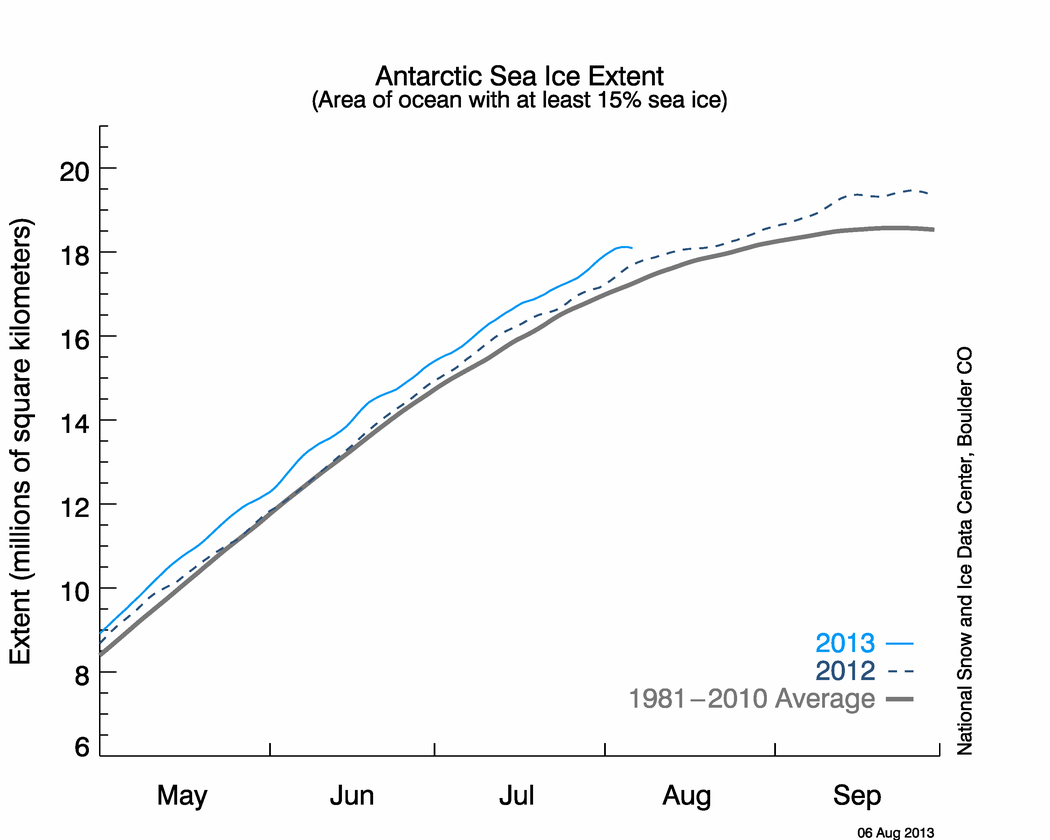

Last year, 2008, was a doozy for ice cover in the Antarctic. It was well above the longer term average. This year is trekking up there as well. So, Mr Garrett it looks like those that are measuring the data are right, and you are wrong. The Antarctic is getting colder.
But, hold on. All that indicates is a fluctuating weather pattern. It does not signify that global warming is not taking place. A local blog, Adding Noughts, tells us that the global warmists have long accounted for the Antarctic ice expansion as an exception that proves the rule of global warming. Apparently, the climate models allow for "temporary" cooling in some isolated parts of the globe, particularly in the Antarctic, even while warming is occurring.
Adding Noughts refers us to the US agency the National Snow and Ice Data Center
Another important point is that the increase in Antarctic sea ice extent is not surprising to climate scientists. When scientists refer to global warming, they don’t mean warming will occur everywhere on the planet at the same rate. In some places, temporary cooling may even occur. Antarctica is an example of regional cooling. Even our earliest climate models projected that Antarctica would be much slower in responding to rising greenhouse gas concentrations than the Arctic. In large part, this reflects the nature of the ocean structure in Antarctica, in which water warmed at the surface quickly mixes downward, making it harder to melt ice.
So, everyone can disregard Antarctica. It's not important in the overall scheme of things. But the Arctic--that's another story. Noughts again refers us to the US Ice Agency to explain why everyone needs to focus upon the ice reductions in the Arctic, not the Antarctic.
Unlike Arctic sea ice, Antarctic sea ice disappears almost completely during the summer, and has since scientists have studied it. Earth’s climate system over thousands of years has been "in tune" with this annual summertime disappearance of Antarctic sea ice. However, satellite records and pre-satellite records indicate that the Arctic has not been free of summertime sea ice for at least 5,500 years and possibly for 125,000 years. So Earth’s climate system and ecosystems, as they exist today, did not develop in conjunction with an ice-free Arctic. Such an ice-free Arctic summer environment would be a change unprecedented in modern human history and could have ramifications for climate around the worldHmmm. "Unprecedented in modern human history?" It would seem that either some people have remarkably short memories, or they are just sloppy in their knowledge of the past. Does one sense a smidgin of special pleading here?
Once again, let's go to the actual data. Below is a graphic of northern hemisphere sea ice area over the past 365 days.


The line at the bottom of the graph provides the anomaly--which tells us that Arctic sea ice is below average. But it also shows us that it is not far below--and in fact right now it is very close to being right where the longer term average says it should be.
So, the Arctic is really critical in the evidential bulwark of global warming. And the evidence is that the sea ice is about average. Around about now, global warmists should be licking their wounds.
And, oh, one slight problem with the insistence upon the Arctic being the "real deal" as far as evidence of global warming goes--it was largely free of ice in the fifteenth century. And Amundsen navigated the North West passage in 1903 to 1906. Obviously the deterioration and declension of Arctic ice in those cases had nothing whatsoever to do with anthropogenic global warming.
And here is another embarrassing set of data: Anthony Watts reproduces the activities of US nuclear submarines in the Arctic in 1958 and 1959. They were able to surface right at the Pole. Ice was really, really thin, if non-existent. So for an event which allegedly is unprecedented in human history, the photographic evidence and the accompanying data is an acute embarrassment. Read the piece at Watts Up With That--but we will entice your taste buds with just one photograph:

But who wants to have facts get in the way of the thrill of being in a horror movie. Give me those spine-tingling banshee wails any day.
Tuesday, 28 April 2009
Ten Lessons From Our Fathers
Wisdom Mediated Through History
Dr James Spiegel, lecturer in philosophy at Taylor University, Indiana provides his take on ten lessons from Great Christian minds. He also provides a brief exposition and citation on why each particular lesson has been so significant. It is worth a read.
The lessons are:
#1—Augustine (5th century): Remember that you are a citizen of another kingdom.
#2—Martin Luther (16th century): Expect politicians to be corrupt.
#3—Thomas Aquinas (13th century): God has made himself known in nature.
#4—John Calvin (16th century): God is sovereign over all, including our suffering.
#5—Jonathan Edwards (18th century): God is beautiful, and all beauty is divine.
#6—Thomas a’Kempis (15th century): Practice self-denial with a passion.
#7—John Wesley (18th century): Be disciplined and make the best use of your time.
#8—Fyodor Dostoevsky (19th century): God’s grace can reach anyone.
#9—Dietrich Bonhoeffer (20th century): Beware of cheap grace.
#10—Alvin Plantinga (21st century): Moral virtue is crucial for intellectual health.
Hat Tip: Between Two Worlds
An interesting exercise would be for each to make up a similar list, with appropriate justification.
Dr James Spiegel, lecturer in philosophy at Taylor University, Indiana provides his take on ten lessons from Great Christian minds. He also provides a brief exposition and citation on why each particular lesson has been so significant. It is worth a read.
The lessons are:
#1—Augustine (5th century): Remember that you are a citizen of another kingdom.
#2—Martin Luther (16th century): Expect politicians to be corrupt.
#3—Thomas Aquinas (13th century): God has made himself known in nature.
#4—John Calvin (16th century): God is sovereign over all, including our suffering.
#5—Jonathan Edwards (18th century): God is beautiful, and all beauty is divine.
#6—Thomas a’Kempis (15th century): Practice self-denial with a passion.
#7—John Wesley (18th century): Be disciplined and make the best use of your time.
#8—Fyodor Dostoevsky (19th century): God’s grace can reach anyone.
#9—Dietrich Bonhoeffer (20th century): Beware of cheap grace.
#10—Alvin Plantinga (21st century): Moral virtue is crucial for intellectual health.
Hat Tip: Between Two Worlds
An interesting exercise would be for each to make up a similar list, with appropriate justification.
Monday, 27 April 2009
Meditation on the Text of the Week
Laying Waste to Hell
The real point of debate was whether the text would actually sustain the weight which the Roman Catholic church sought to place upon it. In the post-Reformation period, when the catholic (that is, universal) Christian church is facing the threat of militant Unbelief at every point and on every front, the issue has faded in importance. There are other more pressing things Christendom needs to focus upon.
No doubt in another future era the issues will be canvassed once again, and the Church will focus upon the proper exegetical meaning of our text. Nonetheless, our text remains more vital and more relevant than ever before. For its significance to our age is now unquestioned; the text needs (or rather our minds need) to be liberated from the Reformational debates and we need to believe upon its promises once more.
For our part, we believe the classic Protestant view is correct: that Peter and the apostles were the foundation stones of the Church. This position of being the fundamental ground of the Church, as Paul also declares in Ephesians 2: 20) did not belong to them as isolated individuals, but as that special college of men to whom God had revealed that Jesus of Nazareth was the Messiah and was also the Son of the Living God.
Upon the rock of apostolic revealed and professed faith in Christ, the Lord would build His Church. Here we have the first indication of why this text is so relevant and important in our day. The Lord declares that the building of the Church—its truth, its light, its power, its influence, its extension and significance in the world—is His work. He will build it, not men. He will use men, but will not be dependant upon them. It is heaven which will inspire and empower men as His servants.
As the forces of Unbelief mount and gather strength in the Western world many a Christian may become timorous and fearful. Many may be tempted to consider placating the foe, or seek some accommodation with the latter day Athens before it is too late. Better to save something than lose everything. Not so. It is the Lord who builds His Church. Either we would be willing stones in the grand enterprise, or we will be rejected.
This leads to the second reason why our text is so vital to our day. The Lord's building of the Church would be so powerful, declares our text, that the gates of Hell would not be able to withstand it. Now, let us mark well, that is not how many in our day understand the Lord's words. They have not had the faith to hear them and receive them.
Through most of the previous century the Christian Church went through a long night of pessimism. It deserved to do so in many ways, for at the beginning of the twentieth century, in general, the Church in the West had got caught up with the widespread optimism of progress and prosperity that the ideology of the Enlightenment was busy pushing everywhere. Truth, reason, justice, liberty, peace, prosperity—the universal reign of goodness—was just around the corner. Mankind was on the cusp of the new heavens and the new earth. The Church had confused secular rationalistic idolatry with the Christian faith. It conflated them so that they were regarded as one and the same. The West was the Christian faith, and the Christian faith was the West. It was a most pernicious idolatry to which much of Jerusalem had become suborned and subverted.
But the Lord does not tolerate idols in His presence. So, what followed was the bloodiest, most turbulent century yet known to mankind. As a result a deep pessimism spread through the Western churches. As the idolatry collapsed, so the optimism engendered by the idol dissipated. It was replaced by fear and doubt. The end was nigh. Things were getting worse. Evil would triumph. Eschatological visions of war, collapse, devastation, followed by beliefs in the imminence of the Final Advent of our Lord to rescue the last Christian remnant off the planet before its conflagration. Such views became widespread and commonplace.
But this pessimism was yet a further doubting and unbelieving response to the Lord's discipline upon the Western churches for their joining and participating in the godless humanism of the post-Enlightenment West in the first place. It was just one more idol nurtured in the heart of Jerusalem. But our text became a favorite proof text of the pessimists. They misunderstood the Lord to be saying here that the Church would become a smaller and smaller island amidst a rising sea of hellishness. Yet, Hell would not wipe out the Church; it would abide and remain—a pitiful remnant to be sure, but it would not be extinguished.
But this was fear perverting the text. The Lord is actually declaring the exact opposite. It is Hell which is under siege, and the besieger is His Church. Hell is a fortress city, trying to hold back the forces of Messiah which is waging war with weapons not of this world. Hell has raised its bulwarks high, but it will fail. Its gates will be broken down. Hell will be entered into, broken down, and plundered. Hell will not be able to withstand the onslaught of the Church. As someone once acutely observed, in the ancient world gates were defensive constructions, not offensive. The fearful pessimism of the Western churches in the twentieth century had led to them being “read” as the exact opposite. This is how fear can distort faith, and even pervert the plain and obvious meaning of the Scriptures.
An example of the prevailing pessimistic fear can be found in the translation of our text in the NASB. It reads, “and the gates of Hell shall not overpower it.” The NIV translates the word as “overcome”. Both these translations imply that it is Hell which is the aggressor, and the Church is the defendant. But the actual Greek word means “to prevail against” or “to withstand”. Thus, in the context of our text, if Hell were to overpower the church Jesus would be telling us that the gates of Hell would be able to withstand successfully the onslaught of the Church, whereas our Lord declares the opposite.
If our Lord had said, the armies, rather than the gates of Hell shall not overpower the Church, there may be some warrant for these translations. But the reference to gates clearly places Hell in the defensive, not the offensive frame.
With the rise of militant and aggressive Unbelief, what is needed now is to revert to our Lord's declaration in our text and let it speak with its plain, obvious truth. In the end, the forces of Unbelief are paper tigers. Evil is self-destructive. It integrates into its own void. It destroys itself upon the rocks of its own confusion and contradictions. It tears itself apart from the inside—for the Lord makes it so. The Lord is building His Church. Hell will not be able to withstand it. Its gates will be torn down and laid waste.
The Lord declares, through His servant Paul, that the weapons of our warfare are not of this world, but they are powerful for the tearing down of every thought, word, and deed raised up against the Son of God. As the forces of secular humanism wax, so their downfall will be the more certain. The Lord will make it so. It is He who builds His Church. It is He who has decreed the destruction of Hell's defences. None can stay His hand. So let us believe. So let us act.
And I also say to you that you are Peter, and upon this rock I will build My church; and the gates of Hades shall not overpower it.The text for this week has been one of not inconsiderable controversy within Christendom over the centuries—a controversy which has now essentially passed. The issue at hand was whether our Lord sanctioned the primacy of the Roman Catholic church in this text. It was a debate which saw the Orthodox and the Western churches take different sides in the medieval period. The issue was also debated strongly during the centuries of the European Reformation, as one would expect.
Matthew 16:18
The real point of debate was whether the text would actually sustain the weight which the Roman Catholic church sought to place upon it. In the post-Reformation period, when the catholic (that is, universal) Christian church is facing the threat of militant Unbelief at every point and on every front, the issue has faded in importance. There are other more pressing things Christendom needs to focus upon.
No doubt in another future era the issues will be canvassed once again, and the Church will focus upon the proper exegetical meaning of our text. Nonetheless, our text remains more vital and more relevant than ever before. For its significance to our age is now unquestioned; the text needs (or rather our minds need) to be liberated from the Reformational debates and we need to believe upon its promises once more.
For our part, we believe the classic Protestant view is correct: that Peter and the apostles were the foundation stones of the Church. This position of being the fundamental ground of the Church, as Paul also declares in Ephesians 2: 20) did not belong to them as isolated individuals, but as that special college of men to whom God had revealed that Jesus of Nazareth was the Messiah and was also the Son of the Living God.
Upon the rock of apostolic revealed and professed faith in Christ, the Lord would build His Church. Here we have the first indication of why this text is so relevant and important in our day. The Lord declares that the building of the Church—its truth, its light, its power, its influence, its extension and significance in the world—is His work. He will build it, not men. He will use men, but will not be dependant upon them. It is heaven which will inspire and empower men as His servants.
As the forces of Unbelief mount and gather strength in the Western world many a Christian may become timorous and fearful. Many may be tempted to consider placating the foe, or seek some accommodation with the latter day Athens before it is too late. Better to save something than lose everything. Not so. It is the Lord who builds His Church. Either we would be willing stones in the grand enterprise, or we will be rejected.
This leads to the second reason why our text is so vital to our day. The Lord's building of the Church would be so powerful, declares our text, that the gates of Hell would not be able to withstand it. Now, let us mark well, that is not how many in our day understand the Lord's words. They have not had the faith to hear them and receive them.
Through most of the previous century the Christian Church went through a long night of pessimism. It deserved to do so in many ways, for at the beginning of the twentieth century, in general, the Church in the West had got caught up with the widespread optimism of progress and prosperity that the ideology of the Enlightenment was busy pushing everywhere. Truth, reason, justice, liberty, peace, prosperity—the universal reign of goodness—was just around the corner. Mankind was on the cusp of the new heavens and the new earth. The Church had confused secular rationalistic idolatry with the Christian faith. It conflated them so that they were regarded as one and the same. The West was the Christian faith, and the Christian faith was the West. It was a most pernicious idolatry to which much of Jerusalem had become suborned and subverted.
But the Lord does not tolerate idols in His presence. So, what followed was the bloodiest, most turbulent century yet known to mankind. As a result a deep pessimism spread through the Western churches. As the idolatry collapsed, so the optimism engendered by the idol dissipated. It was replaced by fear and doubt. The end was nigh. Things were getting worse. Evil would triumph. Eschatological visions of war, collapse, devastation, followed by beliefs in the imminence of the Final Advent of our Lord to rescue the last Christian remnant off the planet before its conflagration. Such views became widespread and commonplace.
But this pessimism was yet a further doubting and unbelieving response to the Lord's discipline upon the Western churches for their joining and participating in the godless humanism of the post-Enlightenment West in the first place. It was just one more idol nurtured in the heart of Jerusalem. But our text became a favorite proof text of the pessimists. They misunderstood the Lord to be saying here that the Church would become a smaller and smaller island amidst a rising sea of hellishness. Yet, Hell would not wipe out the Church; it would abide and remain—a pitiful remnant to be sure, but it would not be extinguished.
But this was fear perverting the text. The Lord is actually declaring the exact opposite. It is Hell which is under siege, and the besieger is His Church. Hell is a fortress city, trying to hold back the forces of Messiah which is waging war with weapons not of this world. Hell has raised its bulwarks high, but it will fail. Its gates will be broken down. Hell will be entered into, broken down, and plundered. Hell will not be able to withstand the onslaught of the Church. As someone once acutely observed, in the ancient world gates were defensive constructions, not offensive. The fearful pessimism of the Western churches in the twentieth century had led to them being “read” as the exact opposite. This is how fear can distort faith, and even pervert the plain and obvious meaning of the Scriptures.
An example of the prevailing pessimistic fear can be found in the translation of our text in the NASB. It reads, “and the gates of Hell shall not overpower it.” The NIV translates the word as “overcome”. Both these translations imply that it is Hell which is the aggressor, and the Church is the defendant. But the actual Greek word means “to prevail against” or “to withstand”. Thus, in the context of our text, if Hell were to overpower the church Jesus would be telling us that the gates of Hell would be able to withstand successfully the onslaught of the Church, whereas our Lord declares the opposite.
If our Lord had said, the armies, rather than the gates of Hell shall not overpower the Church, there may be some warrant for these translations. But the reference to gates clearly places Hell in the defensive, not the offensive frame.
With the rise of militant and aggressive Unbelief, what is needed now is to revert to our Lord's declaration in our text and let it speak with its plain, obvious truth. In the end, the forces of Unbelief are paper tigers. Evil is self-destructive. It integrates into its own void. It destroys itself upon the rocks of its own confusion and contradictions. It tears itself apart from the inside—for the Lord makes it so. The Lord is building His Church. Hell will not be able to withstand it. Its gates will be torn down and laid waste.
The Lord declares, through His servant Paul, that the weapons of our warfare are not of this world, but they are powerful for the tearing down of every thought, word, and deed raised up against the Son of God. As the forces of secular humanism wax, so their downfall will be the more certain. The Lord will make it so. It is He who builds His Church. It is He who has decreed the destruction of Hell's defences. None can stay His hand. So let us believe. So let us act.
Saturday, 25 April 2009
Losing Ground
Only Certain Kinds of Religion Tolerable
The Washington Post recently carried a piece on how Christian groups and institutions are losing legal battles in the States.
These developments are perfectly consistent with the humanist idolatry of demand rights. Civil liberty is re-defined from its original construction in the founding documents into a demand-rights construct, where everyone is required to tolerate, approbate, serve, and support the particular beliefs and practices of everyone.
Now, of course, this is contradictory and nonsensical. To approbate everything and deny nothing means that one must be forced to adopt a radically agnostic and amoral approach to all of life. The only way in which such a community can be maintained is by force. Since it is clear that not everyone is radically agnostic and amoral (faith groups do exist, after all), they at least must be forced to conform--along with anyone else who has reservations about a particular moral or ethical practice.
The homosexual and other demand-rights activists seek to blur this tyrannical reality by acknowledging that people still have a right to believe what they want in their consciences. It is just that they cannot act according to their beliefs in public--by which they mean, in any interaction with any other person.
Banning religion from the public square has long been a tactic of the anti-Christian brigades. As the foment has continued, increasingly the only tolerable religion is one which is entirely private. Religion cannot be allowed to affect how one raises one's family, educates one's children, runs one's business, or any other public activity. This is exactly the same kind of tolerance accorded the Christian faith by the Soviet Union under Stalin. The Constitution of the USSR prescribed religious liberty, but the observance and practice of one's religion was entirely at the behest and prerogative of the government--and the government insisted that it be an entirely private matter.
Demand rights theories cannot sustain civil liberty. They are a fundamentally inimical to human liberty. Over time the sheep's clothing is removed to reveal the wolf underneath. You cannot demand and enforce approbation, on the one hand, and defend religious liberty of thought, conscience, and practice, on the other, unless you are prepared to do what the Communists did--which was to tolerate only a certain kind of religion--one which was prescribed and proscribed to remain within non-public, private, mental, inner, realms.
It seems as if the Communist approach to religion is finding favour. If so, the United States is about to see the establishment of religion in that country--albeit, an official pagan idolatry which adores the State. New Zealand will likely follow suit, as we always tend to do, in these matters.
The Washington Post recently carried a piece on how Christian groups and institutions are losing legal battles in the States.
Faith organizations and individuals who view homosexuality as sinful and refuse to provide services to gay people are losing a growing number of legal battles that they say are costing them their religious freedom.
The lawsuits have resulted from states and communities that have banned discrimination based on sexual orientation. Those laws have created a clash between the right to be free from discrimination and the right to freedom of religion, religious groups said, with faith losing. They point to what they say are ominous recent examples:
-- A Christian photographer was forced by the New Mexico Civil Rights Commission to pay $6,637 in attorney's costs after she refused to photograph a gay couple's commitment ceremony.
-- A psychologist in Georgia was fired after she declined for religious reasons to counsel a lesbian about her relationship.
-- Christian fertility doctors in California who refused to artificially inseminate a lesbian patient were barred by the state Supreme Court from invoking their religious beliefs in refusing treatment.
-- A Christian student group was not recognized at a University of California law school because it denies membership to anyone practicing sex outside of traditional marriage.
"It really is all about religious liberty for us," said Scott Hoffman, chief administrative officer of a New Jersey Methodist group, the Ocean Grove Camp Meeting Association, which lost a property tax exemption after it declined to allow its beachside pavilion to be used for a same-sex union ceremony. "The protection to not be forced to do something that is against deeply held religious principles."
These developments are perfectly consistent with the humanist idolatry of demand rights. Civil liberty is re-defined from its original construction in the founding documents into a demand-rights construct, where everyone is required to tolerate, approbate, serve, and support the particular beliefs and practices of everyone.
Now, of course, this is contradictory and nonsensical. To approbate everything and deny nothing means that one must be forced to adopt a radically agnostic and amoral approach to all of life. The only way in which such a community can be maintained is by force. Since it is clear that not everyone is radically agnostic and amoral (faith groups do exist, after all), they at least must be forced to conform--along with anyone else who has reservations about a particular moral or ethical practice.
The homosexual and other demand-rights activists seek to blur this tyrannical reality by acknowledging that people still have a right to believe what they want in their consciences. It is just that they cannot act according to their beliefs in public--by which they mean, in any interaction with any other person.
"People seem to say that if you enter the world of commerce, you lose all your First Amendment rights" to free exercise of religion, said Jordan Lorence, senior counsel at the Alliance Defense Fund, a Christian legal organization that has represented several businesses. "They . . . have become nothing more than vending machines, and the government can dictate the conditions under which they dispense their goods and services."
Even when groups opposing homosexuality have prevailed in court, they have gone on to face other setbacks. The Boy Scouts of America won a lawsuit in 2000 because it did not allow openly gay Scouts or Scout leaders. Since then, some private charities have refused to support the Scouts, and some local governments have yanked free use of facilities and other benefits. In Philadelphia, the city is demanding that the Scouts pay $200,000 in annual rent for a building that they had been using rent-free. The dispute is in court.
Banning religion from the public square has long been a tactic of the anti-Christian brigades. As the foment has continued, increasingly the only tolerable religion is one which is entirely private. Religion cannot be allowed to affect how one raises one's family, educates one's children, runs one's business, or any other public activity. This is exactly the same kind of tolerance accorded the Christian faith by the Soviet Union under Stalin. The Constitution of the USSR prescribed religious liberty, but the observance and practice of one's religion was entirely at the behest and prerogative of the government--and the government insisted that it be an entirely private matter.
Demand rights theories cannot sustain civil liberty. They are a fundamentally inimical to human liberty. Over time the sheep's clothing is removed to reveal the wolf underneath. You cannot demand and enforce approbation, on the one hand, and defend religious liberty of thought, conscience, and practice, on the other, unless you are prepared to do what the Communists did--which was to tolerate only a certain kind of religion--one which was prescribed and proscribed to remain within non-public, private, mental, inner, realms.
It seems as if the Communist approach to religion is finding favour. If so, the United States is about to see the establishment of religion in that country--albeit, an official pagan idolatry which adores the State. New Zealand will likely follow suit, as we always tend to do, in these matters.
Friday, 24 April 2009
Sauce for the Goose
Flies on the Wall in Ros Noonan's Office
Joris De Bres (Race Relations Conciliator) walks into the office of his boss, Ros Noonan, Commissioner for Human Rights. "Ros, we have a problem," he announced self-importantly. "Oh, Ok," said Ros. "At least it will give us something to do today. Things have been pretty quiet lately."
"Well," continued De Bres, "you know I am in trouble with McCully and the right wing fascists in the National Party over going to Geneva to the UN Conference on racism."
"Don't worry about that," interjected Ros. "I approved your trip. We can spin it as a demonstration of the independence of our office. It is vital to our human rights and constitutional fabric to have a Commission for Human Rights that is completely independent of the government, etc. etc. Besides, our friends in the Labour caucus have been banking political capital over the government's stupid boycotting of the UN conference. We had a little informal strategy session the other day. They were very pleased that we had decided to send you over. It really showed the up the racist fascist thuggery within the National caucus. A rather neat contretemps, was how Goffie and Kingsy put it. I said thanks, and reminded them that contretemps are my speciality."
"Ros, I appreciate your support. It has been the highlight of my otherwise lacklustre career to date to work with you. But, my spies tell me that this thing has legs. I mean McCully is mad--well, he is more mad than we thought, is what I mean. You know how he struts around parliament like a little Napoleon. Power has gone to his head and we all know there was nothing else in there to begin with, so it's having free rein. I am reliably informed that he has been discussing with Key that the contretemps is inexcusable. It is just too big a contradiction with the Government. I mean independence is one thing, but McCully thinks there is a conspiracy between ourselves and the Labour caucus. Apparently Key agrees. He thinks a suitably high profile sacking would take people's attention away from worrying about losing their own jobs."
"Well," said Ros, after a long thoughtful pause, "that's unfortunate. But it has been really great working with you. We did some good things while it lasted. Will you be wanting a reference?"
"No, no Ros. You don't understand. It's worse than that. McCully has told Key that you are the one who is the contretemps expert, and that we both have to go. And Key agrees, because he hates contretemps."
"Why didn't you tell me, you overrated obsequient," screeched Ros. "I'm your boss. You are supposed to protect me."
"Look," stammered De Bres. "I've got a plan. We've got to do something big and quick--something so big and compelling and public that they won't dare fire us. You know how you said that our finest hour was when we got our Labour colleagues to ban David Irving from coming to New Zealand. It was like the good old days, standing on the barricades. That horrid monstrous little creep who minces around the world denying the Holocaust--we stomped on him. I realised that day that we are people of destiny, Ros--and so did everyone else.
"Cullen bombasted on our behalf in Parliament. Clark exuded her inner beauty over banning the creep. Everyone loved us, especially the Jewish lobby. "
"Oh, no," groaned Noonan. "I had forgotten. Key is Jewish. How could you be so stupid as to go to that horrible UN Conference on racism. No wonder he's mad. It's contretemps every which way."
"Yes," purred the unctuous De Bres, "but I have not forgotten Key's Jewish connection. And that's why we can use our Irving triumph again, and relive the glory days. Key will really appreciate that--and he won't dare fire us, without being seen to be anti Semitic, which would drop his ratings in the polls to Goffie levels."
"I'll believe that when I see it," snapped Ros. "No-one could ever get as low as Goffie. He's a phenomenon in his own right. Ok, so what do we do? How about a big press release on Anzac Day reminding everyone that the Human Rights Commission struck a decisive blow for humanity by courageously working to have David Irving, Holocaust Denier banned from New Zealand, and that was our part in Hitler's downfall."
"No, that's too subtle for National party people. They would not be able to join up the dots. You know how ignorant they are of history. You do have a tendency, Ros, if I may say so, which in its own way is quite charming, to overrate our opponents. That is a mistake Helen (may she never die) avoided. She saw right through them because she could see there was nothing there. No, we need a new uber-obvious Holocaust Denier to ban--one who is a clear and present danger to our land. One so vile, so perverted, so anti-Semitic that John Key and everyone else will just love us for acting against him. "
"Yes, but who?" wailed Ros.
"Mahmoud, of course. He's the biggest Holocaust Denier the world has ever seen. He's full of racist hate. He's in the news. We will come out on Anzac Day (a nice touch, by the way) and call for the Government to ban him from New Zealand. It will take the wind completely out of McSilly's sails. And Key won't dare fire us, because people will think he harbours secret anti-Semite tendencies."
"Ban Ahmadinejad! What a fantastic idea", enthused Ros. "Yes, the little anti-Semite creep. I have really never liked him, you know. And he's Muslim. That's a plus--I mean, a minus. No-one likes them. Everyone will love a ban. And he's homophobic--so Labour will support us too. But hold on, I made a public statement the other day that there was nothing at all anti-Semitic at the UN conference--before I knew McStupid and Key were going to fire us. That's going to make a call for a ban on dirty Ahmadinejad a bit hollow."
"Ah, Ros. That's what makes you so fantastic. It's all about contretemps--and you are really good at that. You were making the perfectly valid point that after all the pro-semites walked out, the only people left were anti-semite ravers, who, of course, could not see their anti-semite forest for the trees."
"Joris! You are wonderful. You are so right. I really am good at contretemps."
Joris De Bres (Race Relations Conciliator) walks into the office of his boss, Ros Noonan, Commissioner for Human Rights. "Ros, we have a problem," he announced self-importantly. "Oh, Ok," said Ros. "At least it will give us something to do today. Things have been pretty quiet lately."
"Well," continued De Bres, "you know I am in trouble with McCully and the right wing fascists in the National Party over going to Geneva to the UN Conference on racism."
"Don't worry about that," interjected Ros. "I approved your trip. We can spin it as a demonstration of the independence of our office. It is vital to our human rights and constitutional fabric to have a Commission for Human Rights that is completely independent of the government, etc. etc. Besides, our friends in the Labour caucus have been banking political capital over the government's stupid boycotting of the UN conference. We had a little informal strategy session the other day. They were very pleased that we had decided to send you over. It really showed the up the racist fascist thuggery within the National caucus. A rather neat contretemps, was how Goffie and Kingsy put it. I said thanks, and reminded them that contretemps are my speciality."
"Ros, I appreciate your support. It has been the highlight of my otherwise lacklustre career to date to work with you. But, my spies tell me that this thing has legs. I mean McCully is mad--well, he is more mad than we thought, is what I mean. You know how he struts around parliament like a little Napoleon. Power has gone to his head and we all know there was nothing else in there to begin with, so it's having free rein. I am reliably informed that he has been discussing with Key that the contretemps is inexcusable. It is just too big a contradiction with the Government. I mean independence is one thing, but McCully thinks there is a conspiracy between ourselves and the Labour caucus. Apparently Key agrees. He thinks a suitably high profile sacking would take people's attention away from worrying about losing their own jobs."
"Well," said Ros, after a long thoughtful pause, "that's unfortunate. But it has been really great working with you. We did some good things while it lasted. Will you be wanting a reference?"
"No, no Ros. You don't understand. It's worse than that. McCully has told Key that you are the one who is the contretemps expert, and that we both have to go. And Key agrees, because he hates contretemps."
"Why didn't you tell me, you overrated obsequient," screeched Ros. "I'm your boss. You are supposed to protect me."
"Look," stammered De Bres. "I've got a plan. We've got to do something big and quick--something so big and compelling and public that they won't dare fire us. You know how you said that our finest hour was when we got our Labour colleagues to ban David Irving from coming to New Zealand. It was like the good old days, standing on the barricades. That horrid monstrous little creep who minces around the world denying the Holocaust--we stomped on him. I realised that day that we are people of destiny, Ros--and so did everyone else.
"Cullen bombasted on our behalf in Parliament. Clark exuded her inner beauty over banning the creep. Everyone loved us, especially the Jewish lobby. "
"Oh, no," groaned Noonan. "I had forgotten. Key is Jewish. How could you be so stupid as to go to that horrible UN Conference on racism. No wonder he's mad. It's contretemps every which way."
"Yes," purred the unctuous De Bres, "but I have not forgotten Key's Jewish connection. And that's why we can use our Irving triumph again, and relive the glory days. Key will really appreciate that--and he won't dare fire us, without being seen to be anti Semitic, which would drop his ratings in the polls to Goffie levels."
"I'll believe that when I see it," snapped Ros. "No-one could ever get as low as Goffie. He's a phenomenon in his own right. Ok, so what do we do? How about a big press release on Anzac Day reminding everyone that the Human Rights Commission struck a decisive blow for humanity by courageously working to have David Irving, Holocaust Denier banned from New Zealand, and that was our part in Hitler's downfall."
"No, that's too subtle for National party people. They would not be able to join up the dots. You know how ignorant they are of history. You do have a tendency, Ros, if I may say so, which in its own way is quite charming, to overrate our opponents. That is a mistake Helen (may she never die) avoided. She saw right through them because she could see there was nothing there. No, we need a new uber-obvious Holocaust Denier to ban--one who is a clear and present danger to our land. One so vile, so perverted, so anti-Semitic that John Key and everyone else will just love us for acting against him. "
"Yes, but who?" wailed Ros.
"Mahmoud, of course. He's the biggest Holocaust Denier the world has ever seen. He's full of racist hate. He's in the news. We will come out on Anzac Day (a nice touch, by the way) and call for the Government to ban him from New Zealand. It will take the wind completely out of McSilly's sails. And Key won't dare fire us, because people will think he harbours secret anti-Semite tendencies."
"Ban Ahmadinejad! What a fantastic idea", enthused Ros. "Yes, the little anti-Semite creep. I have really never liked him, you know. And he's Muslim. That's a plus--I mean, a minus. No-one likes them. Everyone will love a ban. And he's homophobic--so Labour will support us too. But hold on, I made a public statement the other day that there was nothing at all anti-Semitic at the UN conference--before I knew McStupid and Key were going to fire us. That's going to make a call for a ban on dirty Ahmadinejad a bit hollow."
"Ah, Ros. That's what makes you so fantastic. It's all about contretemps--and you are really good at that. You were making the perfectly valid point that after all the pro-semites walked out, the only people left were anti-semite ravers, who, of course, could not see their anti-semite forest for the trees."
"Joris! You are wonderful. You are so right. I really am good at contretemps."
Thursday, 23 April 2009
Scholastic Mythbusters, Part IV
Concluding Reflections
For the past two hundred years or so the Western world has taken great pride in science and the scientific method. The scientific method has become a propaganda front for empiricist rationalism. It propounds the neutrality and objectivity of human reason. It boasts of the autonomous ability of the mind of man to determine truth for itself, without precommitments or prejudice. It proclaims that the facts, are the facts, are the facts. The facts have a brute quality. In the end the facts or the data are asserted to speak through all errors, false ideas, and distorted views.
This breathtaking arrogance has led us into a state where the liberal academic complex plays tricks on itself. It has led to academia easily getting sucked in to myths which it then busily cloaks with claims about evidence and proof. The proof or the evidence turns out to be little more than selective fitting up to adorn the case.
When it comes to all human activity, and especially research and scholarship, objectivity requires that at all times the scholar remains self-conscious of his assumptions, precommitments and prejudices. He must be overt about his “conditioning” or his starting points and his biases as he researches, studies, and draws conclusions. This is the paradox of objectivity. In order to achieve true objectivity, the knower must be self-conscious—that is, he must be conscious and overt about his subjective state before he can achieve reasonable objectivity. In arguing his case, he must be transparent to others about his precommitments and prejudices. You first have to know yourself, before you can know anything else.
It is this prevailing lack of honesty and integrity about the “knower” that has distorted so much of what is “known”. It is what has seduced much of the liberal academic complex into believing myths. Michael Polanyi has argued that much of modern science is nothing more than intuition and guesswork. He believes that this is not a bad thing—in fact, it is inevitable. But the intuition and guesswork takes place within a context, an intellectual and scientific tradition which all scientists are taught as an apprentice learns from a master craftsman—and about which they must remain self-conscious at all times. Once they have mastered the tradition, they guess, then they test and examine—and that leads to advances in knowledge.
But this in turn leads to significant and irreversible changes in theory and conclusions. Today's scientists think very differently about matter and the structure of the material world than they did one hundred years ago. The facts are not quite what they seemed—it turns out. There is nothing wrong with this: it only becomes destructive or harmful when scholars turn a particular set of framed data into an undoubted infallible orthodoxy.
It is not by chance that the examples of myths provided in our earlier posts all revolved around a recasting of history. The study of the past is one of those disciplines which is particularly susceptible to revision (“revisionism” was coined to describe the outcome of changing a “narrative” about the past) and to framing. Because all historical study is selective in its data mining and is concerned to produce a narrative or account or story, the risks of getting it wrong are considerable. When brute objectivity is assumed from the outset, the risks rise exponentially.
It is not by accident that the most persistent and powerful myth of our age—the cosmogony of evolutionism—is an attempt to construct a narrative about the past. Data is mined to construct and reconstruct the pattern. Polanyi describes how scientists must make value judgments every day.
Nor is it an accident that another powerful emerging mythical narrative is anthropogenic global warming. If narratives of historical cosmogony are necessarily thick with surmises and suppositions, prognostications of the future must be equally so.
Yet, in time, we believe both the myth of the evolutionist cosmogony and of anthropogenic global warming will be exposed and exploded for what they are: falsehoods. But whilst the hubris of Western rationalism retains its grip, the myths will endure and remain powerful conditioners of our times.
For the past two hundred years or so the Western world has taken great pride in science and the scientific method. The scientific method has become a propaganda front for empiricist rationalism. It propounds the neutrality and objectivity of human reason. It boasts of the autonomous ability of the mind of man to determine truth for itself, without precommitments or prejudice. It proclaims that the facts, are the facts, are the facts. The facts have a brute quality. In the end the facts or the data are asserted to speak through all errors, false ideas, and distorted views.
This breathtaking arrogance has led us into a state where the liberal academic complex plays tricks on itself. It has led to academia easily getting sucked in to myths which it then busily cloaks with claims about evidence and proof. The proof or the evidence turns out to be little more than selective fitting up to adorn the case.
When it comes to all human activity, and especially research and scholarship, objectivity requires that at all times the scholar remains self-conscious of his assumptions, precommitments and prejudices. He must be overt about his “conditioning” or his starting points and his biases as he researches, studies, and draws conclusions. This is the paradox of objectivity. In order to achieve true objectivity, the knower must be self-conscious—that is, he must be conscious and overt about his subjective state before he can achieve reasonable objectivity. In arguing his case, he must be transparent to others about his precommitments and prejudices. You first have to know yourself, before you can know anything else.
It is this prevailing lack of honesty and integrity about the “knower” that has distorted so much of what is “known”. It is what has seduced much of the liberal academic complex into believing myths. Michael Polanyi has argued that much of modern science is nothing more than intuition and guesswork. He believes that this is not a bad thing—in fact, it is inevitable. But the intuition and guesswork takes place within a context, an intellectual and scientific tradition which all scientists are taught as an apprentice learns from a master craftsman—and about which they must remain self-conscious at all times. Once they have mastered the tradition, they guess, then they test and examine—and that leads to advances in knowledge.
But this in turn leads to significant and irreversible changes in theory and conclusions. Today's scientists think very differently about matter and the structure of the material world than they did one hundred years ago. The facts are not quite what they seemed—it turns out. There is nothing wrong with this: it only becomes destructive or harmful when scholars turn a particular set of framed data into an undoubted infallible orthodoxy.
It is not by chance that the examples of myths provided in our earlier posts all revolved around a recasting of history. The study of the past is one of those disciplines which is particularly susceptible to revision (“revisionism” was coined to describe the outcome of changing a “narrative” about the past) and to framing. Because all historical study is selective in its data mining and is concerned to produce a narrative or account or story, the risks of getting it wrong are considerable. When brute objectivity is assumed from the outset, the risks rise exponentially.
It is not by accident that the most persistent and powerful myth of our age—the cosmogony of evolutionism—is an attempt to construct a narrative about the past. Data is mined to construct and reconstruct the pattern. Polanyi describes how scientists must make value judgments every day.
The scientist in pursuit of research has incessantly to make decisions whether to take a new instrument reading or some other new sense impression as signifying a new fact, or to regard it merely as a new indication of an old fact—or else to reject it as having no significance at all. These decisions are guided by the premisses of science and more particularly by the current surmises of the time, but ultimately there always enters an element of personal judgement. Michael Polanyi, Science Faith and Society (London: University of Chicago, 1946), p. 90.In contrast to the hard sciences, of which Polanyi is speaking, the influences of premisses, surmises, and value judgements are far greater when one is attempting to create and "prove" a naturalistic cosmogony because, after all, one was not there at the time. The evolutionist cosmogony, potent myth and narrative that it is, derives its potency from sources other than the data, which, in the very nature of the case are racked to ruin with surmises and value judgements and fitting.
Nor is it an accident that another powerful emerging mythical narrative is anthropogenic global warming. If narratives of historical cosmogony are necessarily thick with surmises and suppositions, prognostications of the future must be equally so.
Yet, in time, we believe both the myth of the evolutionist cosmogony and of anthropogenic global warming will be exposed and exploded for what they are: falsehoods. But whilst the hubris of Western rationalism retains its grip, the myths will endure and remain powerful conditioners of our times.
Wednesday, 22 April 2009
First Modern Turkish Martyrs
We are One With Them
From a press release:
April 18, 2007, two Turkish Christians and a German missionary were tortured and killed inside a Bible Publishing house in Malatya, Turkey.
Summer 2008, two young filmmakers from Texas set out to create Malatya, a documentary exploring how three Christian martyrs have shaken the nation’s roots.
Necati Aydin, Uğur Yuksel and Tilmann Geske were tied to their chairs, tortured with butcher knives and killed for worshiping Christ. Semse Aydin and Susanne Geske, the wives of Necati and Tilmann, both contributed to the film. Echoing Christ’s words from the cross, they’ve publicly forgiven those guilty of their husbands’ deaths. Resources for Christian counseling are scarce in Turkey, a country of nearly 72 million, 99.8 percent of which is Muslim. This has left their surviving families and friends with little human support to lean on in a nationwide church of around 3,000 believers. The joy they find is purely in the hope of their sovereign God working through this time of trial for His glory and their good.
Testimony from leaders of the Turkish church shows even before the martyrdom, Turkish Christians faced persecution. They were unlawfully jailed, interrogated about their activities and even tortured. The deaths of these men have crossed a new line. Attacks and attempted murders have increased since the Malatya martyrdom. The current leader of the Turkish Protestant Alliance, Zekai Tanyar, told the filmmakers, "Before this, I would have said that we do suffer, but I wouldn't call the Turkish Church 'the Persecuted Church,' but all of a sudden, we are the persecuted church."
Turkish pastors revealed to the filmmakers the rise in persecution following the martyrdom has led many in the church to quit attending their fellowships or fall away from their faith all together. Others however have grown bolder in ministry, both in the sharing of their faith and serving in their churches, fully aware any church could be the next victim of violence.
Malatya also covers how the ongoing trial against the murder suspects has gained nationwide coverage in Turkey, where religious freedom is established by law. While some Turks think any Christian in Turkey must be a foreigner, and likely a subversive, thus championing the martyrdom in the name of patriotism, others despise the martyrdom as a hate crime. Turks now face a cultural dilemma: for the first since the founding of their republic, Turkish Christians were martyred.
Malatya is scheduled for DVD release across the globe April 18, 2009, the two-year anniversary of the martyrdom. Screenings are scheduled from Austin to Brazil, the UK, Germany, South Africa, Australia and more.
HatTip: Between Two Worlds
PS: how deeply troubling it must be for American Christians hearing their President congratulate and embrace Turkey in his recent visit, whilst their brethren have been martyred at the hands of consistent Islamists, and whilst Turkey remains divided over whether it is a bad thing or not. He could have done so much to strengthen the hands of those in Turkey who are horrified at the murders, and shame those who are not. He could also have done much to encourage the Christian minority. That he did neither is cause for sadness.
From a press release:
April 18, 2007, two Turkish Christians and a German missionary were tortured and killed inside a Bible Publishing house in Malatya, Turkey.
Summer 2008, two young filmmakers from Texas set out to create Malatya, a documentary exploring how three Christian martyrs have shaken the nation’s roots.
Necati Aydin, Uğur Yuksel and Tilmann Geske were tied to their chairs, tortured with butcher knives and killed for worshiping Christ. Semse Aydin and Susanne Geske, the wives of Necati and Tilmann, both contributed to the film. Echoing Christ’s words from the cross, they’ve publicly forgiven those guilty of their husbands’ deaths. Resources for Christian counseling are scarce in Turkey, a country of nearly 72 million, 99.8 percent of which is Muslim. This has left their surviving families and friends with little human support to lean on in a nationwide church of around 3,000 believers. The joy they find is purely in the hope of their sovereign God working through this time of trial for His glory and their good.
Testimony from leaders of the Turkish church shows even before the martyrdom, Turkish Christians faced persecution. They were unlawfully jailed, interrogated about their activities and even tortured. The deaths of these men have crossed a new line. Attacks and attempted murders have increased since the Malatya martyrdom. The current leader of the Turkish Protestant Alliance, Zekai Tanyar, told the filmmakers, "Before this, I would have said that we do suffer, but I wouldn't call the Turkish Church 'the Persecuted Church,' but all of a sudden, we are the persecuted church."
Turkish pastors revealed to the filmmakers the rise in persecution following the martyrdom has led many in the church to quit attending their fellowships or fall away from their faith all together. Others however have grown bolder in ministry, both in the sharing of their faith and serving in their churches, fully aware any church could be the next victim of violence.
Malatya also covers how the ongoing trial against the murder suspects has gained nationwide coverage in Turkey, where religious freedom is established by law. While some Turks think any Christian in Turkey must be a foreigner, and likely a subversive, thus championing the martyrdom in the name of patriotism, others despise the martyrdom as a hate crime. Turks now face a cultural dilemma: for the first since the founding of their republic, Turkish Christians were martyred.
Malatya is scheduled for DVD release across the globe April 18, 2009, the two-year anniversary of the martyrdom. Screenings are scheduled from Austin to Brazil, the UK, Germany, South Africa, Australia and more.
HatTip: Between Two Worlds
PS: how deeply troubling it must be for American Christians hearing their President congratulate and embrace Turkey in his recent visit, whilst their brethren have been martyred at the hands of consistent Islamists, and whilst Turkey remains divided over whether it is a bad thing or not. He could have done so much to strengthen the hands of those in Turkey who are horrified at the murders, and shame those who are not. He could also have done much to encourage the Christian minority. That he did neither is cause for sadness.
Tuesday, 21 April 2009
Deflation or Inflation?
Scylla and Charybdis Redivivus
Well, which is it to be? Is the world heading into another bout of inflation, or will deflation be the order of the day? Neither option is attractive.
Ever since governments assumed the power to print money with no hard precious metal backing, inflation (hidden theft) has been a major risk to national and global economies. In the last three decades of the previous century controlling and reducing inflation has been the major focus of most central banks in the developed world.
However, many argue that deflation is a more serious threat.
Deflation comes in two forms: benign and ugly. Benign inflation occurs when an economy is steadily growing in productivity, leading to a gradual decrease in the cost of living over time. We have seen this and example of this form of deflation from the electronic revolution. Generally, every year for the same or lower cost you could buy a more sophisticated cell phone, full of more features. This is benign deflation. It is production led. It discourages debt and rewards saving.
Ugly deflation is where an economy is shrinking, incomes are falling, unemployment is rising, people are not spending and the prices of goods and services are generally falling. Ugly deflation is demand led--that is, it is led by falling demand, leading to lower standards of living, or increasing poverty. This is the form of deflation we are facing now. Ugly deflation. It is what stops Ben Bernanke sleeping at nights.
Hyper inflation and ugly deflation are both alike very, very bad news.
Economic pundits are arguing which is likely to emerge as a result of the current global delevering (debt reduction), on the one hand, and the policy responses on the other--which have essentially involved huge increases in deficit spending by governments and monetary stimuli by central banks.
Clearly right now inflation is not a problem. Prices are falling. But every so often commentators will put their heads above the parapet to argue that hyper-inflation is just around the corner.
Here is a taste from Henry Blodget:
Those reasons, particularly the last three, are pretty substantial. We, at Contra Celsum, lean towards the coming hyper-inflation school.
Well, which is it to be? Is the world heading into another bout of inflation, or will deflation be the order of the day? Neither option is attractive.
Ever since governments assumed the power to print money with no hard precious metal backing, inflation (hidden theft) has been a major risk to national and global economies. In the last three decades of the previous century controlling and reducing inflation has been the major focus of most central banks in the developed world.
However, many argue that deflation is a more serious threat.
Deflation comes in two forms: benign and ugly. Benign inflation occurs when an economy is steadily growing in productivity, leading to a gradual decrease in the cost of living over time. We have seen this and example of this form of deflation from the electronic revolution. Generally, every year for the same or lower cost you could buy a more sophisticated cell phone, full of more features. This is benign deflation. It is production led. It discourages debt and rewards saving.
Ugly deflation is where an economy is shrinking, incomes are falling, unemployment is rising, people are not spending and the prices of goods and services are generally falling. Ugly deflation is demand led--that is, it is led by falling demand, leading to lower standards of living, or increasing poverty. This is the form of deflation we are facing now. Ugly deflation. It is what stops Ben Bernanke sleeping at nights.
Hyper inflation and ugly deflation are both alike very, very bad news.
Economic pundits are arguing which is likely to emerge as a result of the current global delevering (debt reduction), on the one hand, and the policy responses on the other--which have essentially involved huge increases in deficit spending by governments and monetary stimuli by central banks.
Clearly right now inflation is not a problem. Prices are falling. But every so often commentators will put their heads above the parapet to argue that hyper-inflation is just around the corner.
Here is a taste from Henry Blodget:
The economy is cratering, so the Fed is printing money. When the Fed prints money, this eventually produces inflation (more dollars, same amount of goods).
Ben Bernanke assured us yesterday that, this time, the Fed's money-printing won't eventually lead to inflation because the moment the economy begins to recover, the Fed will stop printing money and start burning it. Specifically, the Fed will start selling assets instead of buying them and thus shrink the money supply.
Unfortunately, Ben is unlikely to keep this promise.
Why?
Several reasons:
* First, it will be hard to confidently assert that the economy in full recovery. Remember, in 2007, Ben (and most other people) thought the economy was in great shape as far as the eye could see. He and most other observers missed that disastrous turning point. So why do we think he'll correctly spot the next one? Especially because, if he blows it by jacking up rates too early, he'll kill the recovery.
* Second, there will be intense political pressure to MAKE SURE that the economy is in rip-roaring health before hammering consumers and businesses by raising interest rates. Everyone loves low interest rates. And they'll only stop screaming about your taking them away when they're fat and happy (which will be long after inflation really gets going).
* Third, the US government desperately needs low interest rates to fund its soon-to-be-monstrous debt load, so there will be another source of pressure on Ben to keep rates low. When we finish with all this stimulus, we're going to owe a boatload of money. We're really going to allow our Fed chief to send interest rates to the moon and jack up our refinancing costs?
* Fourth, many of the assets that Bernanke has been buying to print money won't be easy to sell. This time around, the Fed isn't just buying easy-to-sell Treasuries. It's buying trash mortgage assets, et al. To reduce the money supply, it will need to sell them to someone. But who?
Those reasons, particularly the last three, are pretty substantial. We, at Contra Celsum, lean towards the coming hyper-inflation school.
Monday, 20 April 2009
Meditation on the Text of the Week
The Light of His Countenance
The perfect analogy is the love of parents for a child. A parent's love is both faithful and constant. It undergirds the entire relationship with the child. It shapes the way the household operates. It sets the household schedules, its preoccupations, the meals, the budgets, and the activities. It is the love of parents for children which shapes the household as a child-centred environment. A parent's love for a child lasts the entire lifetime of the child—as long as the parent lives on the earth. Age does not diminish the love, it only changes its modes of expression.
It is interesting to find that as we have grown older and our children have become adults and parents in their own right, our thoughts and cares and concerns for our children (and now their spouses) have not lessened one wit. We find that our thoughts are constantly bent toward them, daily.
The favour of parents toward a child is for a lifetime. Consequently, the anger of parents towards their children is brief and fleeting. We refer here, of course, to the righteous anger of parents when they must chasten and discipline their children for their wrong doing. The ignominy of bad behaviour provokes the anger; faithfulness leads them to discipline the child. In this context, even the wrath becomes an expression of loyalty, love, and faithfulness.
But these realities of parental love are but a pale reflection of the intensity and the constancy of the love of our Father in heaven toward us. If we being evil are able to love our children in this way, how much more our Father, the Lord of glory.
This is why the people of God are characterised by a perpetual, irrepressible happiness. Clearly God's people suffer—often terribly so—in this life. Sometimes our suffering is due to our own stupid actions. We bear painful consequences of foolish behaviour. But it passes. God's people return again to have the light of God's countenance lifted up upon them.
As our text says, in the most moving of images: weeping may last for the night, but with the morning comes the shout of joy. Most of us have spent more than a few harrowing nights. We have experienced the truth of the proverb that it is darkest just before the dawn. But as the dawn has broken and the sun has risen, the pains and anxieties lessen, and one knows yet again that underneath are the everlasting arms. We know that God will again turn our mourning into dancing and our sackcloth into gladness (verse 11).
The opposite is too fearsome to contemplate. To sense that the entire cosmos is against you and lives in sleepless malice towards you is too great to bear. But that is the essence of the circumstance in which all Unbelievers live. Suppressing the truth about God, they have carelessly sought to give Him the flick. The Bible describes the condition of life of the Unbeliever as one upon whom the wrath of God abides. (John 3:36) Therefore all experiences of love and joy are fleeting, temporary and chimerical. Children will end up hating parents. Parents come to despise and detest their children. Hell is the state where each hates all and all hate each. The implacable wrath of the entire cosmos is known and experienced without end.
This is what our Saviour experienced on the Cross in His descent into Hell. It is from this that our Saviour came to deliver us. While there is still time, while it is still today, we call upon all men to repent and turn from their evil ways, and believe upon Him, for, as the apostle declared, He is the only Name on earth, given by God, amongst men, by which we must be saved.
For His anger is but for a moment; His favour is for a lifetime;Our text portrays the inequality of God's wrath and favour. His anger is temporary, short-lived, soon over. His favour, however, is constant, abiding, and life-long. This means that for His people, the wrath of God occurs only within the context of an already established love and faithfulness. The love and faithfulness of God is the “deeper magic” of life.
Weeping may last for the night, but a shout of joy comes in the morning
Psalm 30:5
The perfect analogy is the love of parents for a child. A parent's love is both faithful and constant. It undergirds the entire relationship with the child. It shapes the way the household operates. It sets the household schedules, its preoccupations, the meals, the budgets, and the activities. It is the love of parents for children which shapes the household as a child-centred environment. A parent's love for a child lasts the entire lifetime of the child—as long as the parent lives on the earth. Age does not diminish the love, it only changes its modes of expression.
It is interesting to find that as we have grown older and our children have become adults and parents in their own right, our thoughts and cares and concerns for our children (and now their spouses) have not lessened one wit. We find that our thoughts are constantly bent toward them, daily.
The favour of parents toward a child is for a lifetime. Consequently, the anger of parents towards their children is brief and fleeting. We refer here, of course, to the righteous anger of parents when they must chasten and discipline their children for their wrong doing. The ignominy of bad behaviour provokes the anger; faithfulness leads them to discipline the child. In this context, even the wrath becomes an expression of loyalty, love, and faithfulness.
But these realities of parental love are but a pale reflection of the intensity and the constancy of the love of our Father in heaven toward us. If we being evil are able to love our children in this way, how much more our Father, the Lord of glory.
This is why the people of God are characterised by a perpetual, irrepressible happiness. Clearly God's people suffer—often terribly so—in this life. Sometimes our suffering is due to our own stupid actions. We bear painful consequences of foolish behaviour. But it passes. God's people return again to have the light of God's countenance lifted up upon them.
As our text says, in the most moving of images: weeping may last for the night, but with the morning comes the shout of joy. Most of us have spent more than a few harrowing nights. We have experienced the truth of the proverb that it is darkest just before the dawn. But as the dawn has broken and the sun has risen, the pains and anxieties lessen, and one knows yet again that underneath are the everlasting arms. We know that God will again turn our mourning into dancing and our sackcloth into gladness (verse 11).
The opposite is too fearsome to contemplate. To sense that the entire cosmos is against you and lives in sleepless malice towards you is too great to bear. But that is the essence of the circumstance in which all Unbelievers live. Suppressing the truth about God, they have carelessly sought to give Him the flick. The Bible describes the condition of life of the Unbeliever as one upon whom the wrath of God abides. (John 3:36) Therefore all experiences of love and joy are fleeting, temporary and chimerical. Children will end up hating parents. Parents come to despise and detest their children. Hell is the state where each hates all and all hate each. The implacable wrath of the entire cosmos is known and experienced without end.
This is what our Saviour experienced on the Cross in His descent into Hell. It is from this that our Saviour came to deliver us. While there is still time, while it is still today, we call upon all men to repent and turn from their evil ways, and believe upon Him, for, as the apostle declared, He is the only Name on earth, given by God, amongst men, by which we must be saved.
Saturday, 18 April 2009
Green Jobs
Foolishness is Bound Up in the Heart of Government
The Law of Unintended Consequences warns us that when governments exceed their God-given sphere of competence the unintended consequences of their actions mean that we are worse off than if nothing was done. The actual outcome is usually the direct opposite of what was intended.
Another way of expressing the law is, beware politicians with a grand vision. Grand visions usually turn out to be grandiose, causing a great deal of unintended harm, pain, and suffering.
The current economic malady has produced a number of grand visions. We have had a few in New Zealand. One example is the "feel good" policy of the government funding home insulation. We are told that this is a win,win,win. Well, that's it then. Who could possibly object?
The protagonists argue thusly: the government needs to spend money to keep the economy from sliding into depression. So, funding home insulation gets a tick. It will fund jobs that would not otherwise exist. Secondly, people will end up with warmer, better insulated homes. This will reduce sickness and disease--thereby lowering public health costs. Tick. In the long run it will reduce government spending. Tick. Thirdly, heating costs will be lower, thereby reducing our "carbon footprint", lowering demands for energy, and reducing our national pollution. Tick.
It has to be good. There simply aren't any downsides. As we said, it is win, win, win. We have shattered the Law of Unintended Consequences!
Well, not quite. Firstly, the government will have spent money it does not have--thus increasing our national debt burden. That is a bad outcome. Secondly, the jobs will be unsustainable. They will exist only by virtue of government subsidy--thus no real long term national wealth based on sustainable production. Meanwhile, there is an opportunity cost. Those home insulators could have been employed in jobs producing goods and services that would be sustainable and productive.
Thirdly, home insulation is likely a crock. Modern methods of home insulation seal up houses so that air is kept within a house. Over time, it entraps moisture in the house, leading to mould and dampness--ideal conditions for respiratory diseases and maladies like colds and flu. Moreover, the more damp a house is, the more energy it takes to heat it, and keep it warm. Thus, the outcome of home insulation is more likely to be greater energy costs and a less healthy population.
Snap. The Law of Unintended Consequences will bite with a vengeance. The actual outcome will be the exact contra-polar opposite of the intent. We expect that within fifteen years we will be hearing how stupid we all were back in the noughties, when home insulation was the official flavour of the decade.
Another example of unintended consequences has recently come to light. Spain has been touted as having a progressive and advanced policy on creating "green jobs" through state subsidisation of "clean energy" projects (wind farms and the like). Now, however, the truth has started to emerge. A study has been undertaken by Dr Gabriel Calzada, an economics professor at Juan Carlos University which has shown that in Spain for every four jobs created through state subsidised green energy projects, nine jobs were lost.
State subsidising of green jobs results in rising unemployment! Now, of course, President Obama has cited Spain as the country he wants to imitate in his green jobs initiative (part of the huge public spending to stimulate the economy.)
Yup. Win, win, win. The guy's a genius. Well, actually, no. Obama's great green energy spending initiative will make energy in the United States more expensive, less efficient and productive, and it will destroy permanent jobs. Moreover, the Spanish study concluded that only one in ten jobs created in the "green energy subsidy" rort actually turned into a permanent job. So even the jobs that were created have largely proved to be impermanent.
But who can gainsay a politician with a grand vision, who chants "yes, we can". Well, no-one. Expect the Law of Unintended Consequences to bite deep and painfully.
The Law of Unintended Consequences warns us that when governments exceed their God-given sphere of competence the unintended consequences of their actions mean that we are worse off than if nothing was done. The actual outcome is usually the direct opposite of what was intended.
Another way of expressing the law is, beware politicians with a grand vision. Grand visions usually turn out to be grandiose, causing a great deal of unintended harm, pain, and suffering.
The current economic malady has produced a number of grand visions. We have had a few in New Zealand. One example is the "feel good" policy of the government funding home insulation. We are told that this is a win,win,win. Well, that's it then. Who could possibly object?
The protagonists argue thusly: the government needs to spend money to keep the economy from sliding into depression. So, funding home insulation gets a tick. It will fund jobs that would not otherwise exist. Secondly, people will end up with warmer, better insulated homes. This will reduce sickness and disease--thereby lowering public health costs. Tick. In the long run it will reduce government spending. Tick. Thirdly, heating costs will be lower, thereby reducing our "carbon footprint", lowering demands for energy, and reducing our national pollution. Tick.
It has to be good. There simply aren't any downsides. As we said, it is win, win, win. We have shattered the Law of Unintended Consequences!
Well, not quite. Firstly, the government will have spent money it does not have--thus increasing our national debt burden. That is a bad outcome. Secondly, the jobs will be unsustainable. They will exist only by virtue of government subsidy--thus no real long term national wealth based on sustainable production. Meanwhile, there is an opportunity cost. Those home insulators could have been employed in jobs producing goods and services that would be sustainable and productive.
Thirdly, home insulation is likely a crock. Modern methods of home insulation seal up houses so that air is kept within a house. Over time, it entraps moisture in the house, leading to mould and dampness--ideal conditions for respiratory diseases and maladies like colds and flu. Moreover, the more damp a house is, the more energy it takes to heat it, and keep it warm. Thus, the outcome of home insulation is more likely to be greater energy costs and a less healthy population.
Snap. The Law of Unintended Consequences will bite with a vengeance. The actual outcome will be the exact contra-polar opposite of the intent. We expect that within fifteen years we will be hearing how stupid we all were back in the noughties, when home insulation was the official flavour of the decade.
Another example of unintended consequences has recently come to light. Spain has been touted as having a progressive and advanced policy on creating "green jobs" through state subsidisation of "clean energy" projects (wind farms and the like). Now, however, the truth has started to emerge. A study has been undertaken by Dr Gabriel Calzada, an economics professor at Juan Carlos University which has shown that in Spain for every four jobs created through state subsidised green energy projects, nine jobs were lost.
State subsidising of green jobs results in rising unemployment! Now, of course, President Obama has cited Spain as the country he wants to imitate in his green jobs initiative (part of the huge public spending to stimulate the economy.)
"Think of what’s happening in countries like Spain, Germany and Japan, where they’re making real investments in renewable energy,” said Obama while lobbying Congress, in January to pass the American Recovery and Reinvestment Act. “They’re surging ahead of us, poised to take the lead in these new industries.”
“Their governments have harnessed their people’s hard work and ingenuity with bold investments — investments that are paying off in good, high-wage jobs — jobs they won’t lose to other countries,” said Obama. “There is no reason we can’t do the same thing right here in America. … In the process, we’ll put nearly half a million people to work building wind turbines and solar panels; constructing fuel-efficient cars and buildings; and developing the new energy technologies that will lead to new jobs, more savings, and a cleaner, safer planet in the bargain.”
Yup. Win, win, win. The guy's a genius. Well, actually, no. Obama's great green energy spending initiative will make energy in the United States more expensive, less efficient and productive, and it will destroy permanent jobs. Moreover, the Spanish study concluded that only one in ten jobs created in the "green energy subsidy" rort actually turned into a permanent job. So even the jobs that were created have largely proved to be impermanent.
But who can gainsay a politician with a grand vision, who chants "yes, we can". Well, no-one. Expect the Law of Unintended Consequences to bite deep and painfully.
Friday, 17 April 2009
Scholastic Mythbusters III
The Dead Sea Scrolls
We have been discussing the prevalence of myth in modern scholarship. While it is not always the case, there have been notable examples of prejudice and cant in the Academy—often lasting generations—where prevailing views alone are heard on a particular topic and all contrary hypotheses are rejected out of hand, if not ridiculed.
So strong can be the hold of the dominant view that anyone who has the temerity to express a different view, or to challenge the prevailing orthodoxy, risks being cast into outer academic darkness. Yet, in time, many of these "orthodox" views are shown to be false and, to employ the euphemism, prejudicial to the truth.
We have argued that the implicit arrogance of rationalism lends itself to such errors and to a kind of naïve credulity. The belief in the autonomy and ultimate veracity of the human mind predisposes the academic elite to an underlying arrogance, which all to often becomes overwhelming.
It is ironic that modern Athens betrays on every hand this worst form of blindness. Ironic, because modern Athens boasts of its enlightened character. Its much vaunted “scientific method”, its scholarship, its institutions of research, its mass media promulgating knowledge far and wide, its halls of learning, its publicly funded education system, its technological prowess—all play a part in reassuring us that modern man is truly advanced, enlightened, and wise. The modern Athenian citizen has banished all superstition and ignorance from the playground. Or, so the mantra runs.
The honest broker or the properly wise commences with a frank disclosure of his fundamental and guiding assumptions. He puts them out there for all to see. He discloses his prejudices and his pre-commitments from the outset. He is rigorously self-conscious of them. Of course, this procedure—the only one which avoids the trap of invincible moral culpable ignorance—would force a great deal of humility into academic and learned debates. That's partly why it is avoided like the plague. Declaring one's pre-commitments from the beginning forces everyone to face up to the fundamental circularity of all knowledge—which, to the modern rationalist, is a deep, if not fatal, embarrassment.
The dishonest broker will not acknowledge his pre-commitments. Rather, he appeals to the neutrality and objectivity of the facts, of the data, and of his “seeing things as they really are”. His claim to authority is based upon the “evidence”. He presents himself as dispassionate, detached, objective. For him, knowledge is not circular because he, the investigator, has not intruded himself onto the facts. He is not part of the factual landscae. His pre-commitments have not informed him throughout. His net has not determined from the outset what fish he will catch. The dishonest broker, by denying the circularity of all knowledge, including his own, ends up being little more than a propagandist.
We have given some examples of how scholarship over many years has perpetrated myths as undoubted fact. The first example was the prevailing myth about the sour bitterness of the Puritans and their rejection of music, gaiety, and the arts. So deep, extensive, and pervasive has been this myth that the adjectives “puritan” and “puritanical” have entered the lexicon, meaning an attitude of bigotry and intolerance. Yet, this slander has now been exploded as a myth. In this case, Voltaire has been proven right: the discipline of history is a cheap trick played upon the dead.
A second example is the overwhelming and near universal rejection of the historicity of the Old Testament and in its place the Academy has insisted that Manetho's chronology of ancient Egypt is the true and accurate historical record. This has controlled (and distorted) the study of the ancient near east for hundreds of years. Opposing views were simply not heard, let alone tolerated.
Now, however, some within the Academy have started to question the prevailing scholastic myth—and the edifice is starting to crumble. When one considers all the errors and distortions built into Manetho's scheme, it is a marvel that it was taken so seriously by such experts for so long.
A further example of scholastic mythmaking comes from a more narrow area of study. It has to do with the Dead Sea Scrolls, which were first discovered (in the modern era) in 1947. The initial discovery was augmented by additional finds over a number of subsequent years. For over 50 years it was asserted that these scrolls were produced by a Jewish sectarian community, the Essenes, living at Qumran on the Dead Sea during the time of the incarnation of Christ our Lord.
This has now finally been demonstrated to have been an egregious error. Not only did the Essenes not produce the scrolls, they had nothing to do with them, and, to add insult to injury, there is no evidence of an Essene community ever having been at Qumran. But for 50 years the error held sway amongst scholars, governments, universities, journals and media. But it held sway in a particular manner: this was not a consensus forged through irenic and open-minded research. Rather it was perpetrated through power politics within the Academy. People that dared to question or expose the prejudice were vilified and their careers jeopardized.
The Scrolls themselves were an amazing archaeological find. They have the potential to shed much light on Judaism during the intertestamental period (300BC to 70AD)--a period when much of Judaica was destroyed and subsequently lost to history. But they have been pushed into a backwater for over fifty years through scholastic prejudice.
Fifty years of error in a supposedly enlightened world! Reputations and careers were made by promulgating the error. Careers were ruined by those with the temerity to question the then current orthodoxy. There is no doubt that the reigning mode of Dead Sea Scrolls scholarship for over half a century was flat out dishonest and culpably ignorant.
How did this happen in such an enlightened, modern age? In a truly remarkable book, Norman Golb, of the University of Chicago, documents a lifetime of fighting the Academy's orthodoxy and the personal and professional cost of doing so. (Norman Golb, Who Wrote the Dead Sea Scrolls? The Search for the Secret of Qumran. [London: BCA, 1995]) He shows how the myth was initially promulgated, took hold, then suppressed contrary views. It occurred very simply. Here are the steps:
1. Initial scroll research asserted the Essence theory without a full disclosure of the fundamental assumptions lying behind the theory which undergirded it. (In this particular case, the assumptions were speculative, baseless, and until recently, never been examined, verified or tested.)
2. Academics began promulgating the theory as established fact—based on the “evidence”. Evidence was "manufactured" to fit the theory. Contrary theories or interpretations were never allowed to intrude.
3. Those who questioned the theory were personally attacked and ridiculed as fantasizing ignoramuses. They were excluded from access to the Scrolls for research purposes.
4. A wilful sociology of ignorance took over. The more the error was stated, the more widely it was promulgated, the more believable it became. Credulity runs in packs. Repetition means truth. Mantras have huge influence in a culture dominated by culpable ignorance.
5. As data or evidence was subsequently found that did not fit with the Essene theory, it was explained away (“the evidence was alleged to have been forged”, etc).
The theory has recently collapsed and has been shown up for the folly that it was from the beginning. So, we had a grand conspiracy—but one where the culpable perpetrators allowed themselves to be duped and then defended their duplicity. Remember these were the best and brightest in their respective fields.
They turned out to be nothing more than propagandists. This arose because they suppressed their starting assumptions.
Now, of course, if they had been honest from the beginning and disclosed them, their initial findings on the origin and provenance of the Scrolls would have been far more tentative, less sensational, more humble, and much more quickly revised and corrected. The circularity would have been evident from the beginning, and therefore much more quickly scrutinized (and in this case, rejected).
A church caretaker once noticed the preacher had left his sermon notes on the pulpit. Scrawled in the margin at one place in the manuscript was the notation: “Weak point—speak more loudly.” The prevailing modern blindness which refuses to accept the circularity of all knowledge and hides fundamental pre-commitments and assumptions has fallen into the same deceit: the modern world thinks that by repeating something loudly and often, it establishes its veracity. Truth becomes a matter of shouting down the opposition. Truth becomes politicized. Truth becomes propaganda.
So, for over fifty years the scrolls were said to have been written by the sect of the Essenes. This is now shown up to patently false. Now scholars have to work out who actually did write them and where they came from. Hopefully, with the blinkers off we will come to understand a whole lot more of the intellectual, cultural and religious world in which our Lord ministered than ever before.
The final nail in the coffin came when archaeologists from the Israel Antiquities Authority (that is, “official” scholars) committed to doing comprehensive archaeological work at the site. The dig took place over ten years. Recently they have reported and concluded that there never was an Essene community at Qumran. In a summary of their findings, the New York Times reported in 2006:
The full preliminary report of the archaeologists can be downloaded here.
The upshot is that now almost every book on New Testament and intertestamental history is out of date and requires significant revision. This is irritating in its own right. But at least another scholastic myth has been exploded. However, if Golb is correct and the scrolls represent part of the (Sadduccean controlled) Temple Library, spirited out of Jerusalem and hidden in the caves to protect them from the Roman siege, they will contribute a great deal to our understanding of those times.
While the particular field of Qumranology may be somewhat esoteric and specialised the case serves to illustrate how the Academy can get things very wrong for a long, long time. We believe this dysfunctional situation is becoming more and more prevalent as rationalism takes hold. The more autonomous rationalism holds sway in the Academy the greater the likelihood of myth and superstition becoming regnant in the liberal-academic complex.
We have been discussing the prevalence of myth in modern scholarship. While it is not always the case, there have been notable examples of prejudice and cant in the Academy—often lasting generations—where prevailing views alone are heard on a particular topic and all contrary hypotheses are rejected out of hand, if not ridiculed.
So strong can be the hold of the dominant view that anyone who has the temerity to express a different view, or to challenge the prevailing orthodoxy, risks being cast into outer academic darkness. Yet, in time, many of these "orthodox" views are shown to be false and, to employ the euphemism, prejudicial to the truth.
We have argued that the implicit arrogance of rationalism lends itself to such errors and to a kind of naïve credulity. The belief in the autonomy and ultimate veracity of the human mind predisposes the academic elite to an underlying arrogance, which all to often becomes overwhelming.
It is ironic that modern Athens betrays on every hand this worst form of blindness. Ironic, because modern Athens boasts of its enlightened character. Its much vaunted “scientific method”, its scholarship, its institutions of research, its mass media promulgating knowledge far and wide, its halls of learning, its publicly funded education system, its technological prowess—all play a part in reassuring us that modern man is truly advanced, enlightened, and wise. The modern Athenian citizen has banished all superstition and ignorance from the playground. Or, so the mantra runs.
The honest broker or the properly wise commences with a frank disclosure of his fundamental and guiding assumptions. He puts them out there for all to see. He discloses his prejudices and his pre-commitments from the outset. He is rigorously self-conscious of them. Of course, this procedure—the only one which avoids the trap of invincible moral culpable ignorance—would force a great deal of humility into academic and learned debates. That's partly why it is avoided like the plague. Declaring one's pre-commitments from the beginning forces everyone to face up to the fundamental circularity of all knowledge—which, to the modern rationalist, is a deep, if not fatal, embarrassment.
The dishonest broker will not acknowledge his pre-commitments. Rather, he appeals to the neutrality and objectivity of the facts, of the data, and of his “seeing things as they really are”. His claim to authority is based upon the “evidence”. He presents himself as dispassionate, detached, objective. For him, knowledge is not circular because he, the investigator, has not intruded himself onto the facts. He is not part of the factual landscae. His pre-commitments have not informed him throughout. His net has not determined from the outset what fish he will catch. The dishonest broker, by denying the circularity of all knowledge, including his own, ends up being little more than a propagandist.
We have given some examples of how scholarship over many years has perpetrated myths as undoubted fact. The first example was the prevailing myth about the sour bitterness of the Puritans and their rejection of music, gaiety, and the arts. So deep, extensive, and pervasive has been this myth that the adjectives “puritan” and “puritanical” have entered the lexicon, meaning an attitude of bigotry and intolerance. Yet, this slander has now been exploded as a myth. In this case, Voltaire has been proven right: the discipline of history is a cheap trick played upon the dead.
A second example is the overwhelming and near universal rejection of the historicity of the Old Testament and in its place the Academy has insisted that Manetho's chronology of ancient Egypt is the true and accurate historical record. This has controlled (and distorted) the study of the ancient near east for hundreds of years. Opposing views were simply not heard, let alone tolerated.
Now, however, some within the Academy have started to question the prevailing scholastic myth—and the edifice is starting to crumble. When one considers all the errors and distortions built into Manetho's scheme, it is a marvel that it was taken so seriously by such experts for so long.
A further example of scholastic mythmaking comes from a more narrow area of study. It has to do with the Dead Sea Scrolls, which were first discovered (in the modern era) in 1947. The initial discovery was augmented by additional finds over a number of subsequent years. For over 50 years it was asserted that these scrolls were produced by a Jewish sectarian community, the Essenes, living at Qumran on the Dead Sea during the time of the incarnation of Christ our Lord.
This has now finally been demonstrated to have been an egregious error. Not only did the Essenes not produce the scrolls, they had nothing to do with them, and, to add insult to injury, there is no evidence of an Essene community ever having been at Qumran. But for 50 years the error held sway amongst scholars, governments, universities, journals and media. But it held sway in a particular manner: this was not a consensus forged through irenic and open-minded research. Rather it was perpetrated through power politics within the Academy. People that dared to question or expose the prejudice were vilified and their careers jeopardized.
The Scrolls themselves were an amazing archaeological find. They have the potential to shed much light on Judaism during the intertestamental period (300BC to 70AD)--a period when much of Judaica was destroyed and subsequently lost to history. But they have been pushed into a backwater for over fifty years through scholastic prejudice.
Fifty years of error in a supposedly enlightened world! Reputations and careers were made by promulgating the error. Careers were ruined by those with the temerity to question the then current orthodoxy. There is no doubt that the reigning mode of Dead Sea Scrolls scholarship for over half a century was flat out dishonest and culpably ignorant.
How did this happen in such an enlightened, modern age? In a truly remarkable book, Norman Golb, of the University of Chicago, documents a lifetime of fighting the Academy's orthodoxy and the personal and professional cost of doing so. (Norman Golb, Who Wrote the Dead Sea Scrolls? The Search for the Secret of Qumran. [London: BCA, 1995]) He shows how the myth was initially promulgated, took hold, then suppressed contrary views. It occurred very simply. Here are the steps:
1. Initial scroll research asserted the Essence theory without a full disclosure of the fundamental assumptions lying behind the theory which undergirded it. (In this particular case, the assumptions were speculative, baseless, and until recently, never been examined, verified or tested.)
2. Academics began promulgating the theory as established fact—based on the “evidence”. Evidence was "manufactured" to fit the theory. Contrary theories or interpretations were never allowed to intrude.
3. Those who questioned the theory were personally attacked and ridiculed as fantasizing ignoramuses. They were excluded from access to the Scrolls for research purposes.
4. A wilful sociology of ignorance took over. The more the error was stated, the more widely it was promulgated, the more believable it became. Credulity runs in packs. Repetition means truth. Mantras have huge influence in a culture dominated by culpable ignorance.
5. As data or evidence was subsequently found that did not fit with the Essene theory, it was explained away (“the evidence was alleged to have been forged”, etc).
The theory has recently collapsed and has been shown up for the folly that it was from the beginning. So, we had a grand conspiracy—but one where the culpable perpetrators allowed themselves to be duped and then defended their duplicity. Remember these were the best and brightest in their respective fields.
They turned out to be nothing more than propagandists. This arose because they suppressed their starting assumptions.
Now, of course, if they had been honest from the beginning and disclosed them, their initial findings on the origin and provenance of the Scrolls would have been far more tentative, less sensational, more humble, and much more quickly revised and corrected. The circularity would have been evident from the beginning, and therefore much more quickly scrutinized (and in this case, rejected).
A church caretaker once noticed the preacher had left his sermon notes on the pulpit. Scrawled in the margin at one place in the manuscript was the notation: “Weak point—speak more loudly.” The prevailing modern blindness which refuses to accept the circularity of all knowledge and hides fundamental pre-commitments and assumptions has fallen into the same deceit: the modern world thinks that by repeating something loudly and often, it establishes its veracity. Truth becomes a matter of shouting down the opposition. Truth becomes politicized. Truth becomes propaganda.
So, for over fifty years the scrolls were said to have been written by the sect of the Essenes. This is now shown up to patently false. Now scholars have to work out who actually did write them and where they came from. Hopefully, with the blinkers off we will come to understand a whole lot more of the intellectual, cultural and religious world in which our Lord ministered than ever before.
The final nail in the coffin came when archaeologists from the Israel Antiquities Authority (that is, “official” scholars) committed to doing comprehensive archaeological work at the site. The dig took place over ten years. Recently they have reported and concluded that there never was an Essene community at Qumran. In a summary of their findings, the New York Times reported in 2006:
New archaeological evidence is raising more questions about the conventional interpretation linking the desolate ruins of an ancient settlement known as Qumran with the Dead Sea Scrolls, which were found in nearby caves in one of the sensational discoveries of the last century.
After early excavations at the site, on a promontory above the western shore of the Dead Sea, scholars concluded that members of a strict Jewish sect, the Essenes, had lived there in a monastery and presumably wrote the scrolls in the first centuries B.C. and A.D.
Many of the texts describe religious practices and doctrine in ancient Israel. But two Israeli archaeologists who have excavated the site on and off for more than 10 years now assert that Qumran had nothing to do with the Essenes or a monastery or the scrolls. It had been a pottery factory.
The archaeologists, Yizhak Magen and Yuval Peleg of the Israel Antiquities Authority, reported in a book and a related magazine article that their extensive excavations turned up pottery kilns, whole vessels, production rejects and thousands of clay fragments. Derelict water reservoirs held thick deposits of fine potters’ clay. . . .
Norman Golb, a professor of Near Eastern languages and civilization at the University of Chicago who is a longtime critic of the Essene link, said he was impressed by the new findings and the pottery-factory interpretation. “Magen’s a very seasoned archaeologist and scholar, and many of his views are cogent,” Dr. Golb said in a telephone interview. “A pottery factory? That could well be the case.”
Dr. Golb said that, of course, Qumran could have been both a monastery and a pottery factory. Yet, he added: “There is not an iota of evidence that it was a monastery. We have come to see it as a secular site, not one of pronounced religious orientation.” For years, Dr. Golb has argued that the multiplicity of Jewish religious ideas and practices recorded in the scrolls made it unlikely that they were the work of a single sect like the Essenes. He noted that few of the texts dealt with specific Essene traditions. Not one, he said, espoused celibacy, which the sect practiced.
The scrolls in the caves were probably written by many different groups, Dr. Golb surmised, and were removed from Jerusalem libraries by refugees in the Roman war. Fleeing to the east, the refugees may well have deposited the scrolls for safekeeping in the many caves near Qumran.
The new research appears to support this view. As Dr. Magen noted, Qumran in those days was at a major crossroads of traffic to and from Jerusalem and along the Dead Sea. Similar scrolls have been found at Masada, the site south of Qumran of the suicidal hold-out against the Romans.
Dr. Magen also cited documents showing that refugees in another revolt against the Romans in the next century had fled to the same caves. He said they were “the last spot they could hide the scrolls before descending to the shore” of the Dead Sea.
The full preliminary report of the archaeologists can be downloaded here.
The upshot is that now almost every book on New Testament and intertestamental history is out of date and requires significant revision. This is irritating in its own right. But at least another scholastic myth has been exploded. However, if Golb is correct and the scrolls represent part of the (Sadduccean controlled) Temple Library, spirited out of Jerusalem and hidden in the caves to protect them from the Roman siege, they will contribute a great deal to our understanding of those times.
While the particular field of Qumranology may be somewhat esoteric and specialised the case serves to illustrate how the Academy can get things very wrong for a long, long time. We believe this dysfunctional situation is becoming more and more prevalent as rationalism takes hold. The more autonomous rationalism holds sway in the Academy the greater the likelihood of myth and superstition becoming regnant in the liberal-academic complex.
Subscribe to:
Posts (Atom)