Showing posts with label UK Parliament. Show all posts

Friday, 6 March 2020

An Unexpected Transformation Scene

Britain Is the First Country to Turn Back the Liberal Tide

Oliver J J Lane
Breitbart London


The United Kingdom bucked the global trend by being the first nation to reverse the march of liberalism but the “profound danger” of woke politics backed by a displaced religious zeal threatens these developments, constitutionalist Dr David Starkey has said.

Speaking to Breitbart London’s James Delingpole, British historian and broadcaster Dr David Starkey noted the sudden and remarkable appearance of woke culture in British and American universities. It was a unique combination of cultural factors in the Anglo-American that allowed this to flourish, he said, remarking:
“The worst excesses of ‘woke’ only happen in the Anglo-Saxon world… one of the driving forces of this, and why it is so prominent in America, one of the elements of it is it professes to be reason, but it is driven by religion. It is a mistaken religious impulse — all of these things are powered by puritanism. It is a peculiarly Anglo-Saxon and American phenomenon.”
Dr Starkey noted the treatment of prominent left-wing political figures as modern-day saints in the new woke-green religion, such as “child saint” Greta Thunberg and UK hard-left leader Jeremy Corbyn. “This is the profound danger we have now, the grotesque excesses of the left are imbued with religious certainty. Corbynism was manifestly a religious movement — look at them all at Glastonbury [chanting Jeremy Corbyn’s name — ‘JC’, like Jesus Christ]. It is this weird displacement of religion”, he said.

But while the Anglo-American sphere produces a breeding ground for radical wokeism, it also provides a unique political system where change is possible without revolution. Pointing to the remarkable survival of British political institutions for 800 years while all others across Europe were pulled down to manifest change, Dr Starkey said this ability of the English constitutional system to adapt to change was not a mere accident of history, but instead a key quality, and one that was recognised and capitalised upon by the nation’s most astute conservative leaders.

Friday, 31 May 2019

The Only Sensible Thing Left to Do

UK Politicians Afraid of the People

For those of our readers who find themselves perpetually interested and curious about our respective histories, Peter Hitchens has written a stimulating piece on the history of Britain and its impact upon national politics--and vice versa.

For some reason that is hard to explain we are drawn back to the history of Great Britain--from Roman times down to the present.  For us, we suspect the sense of connection is spiritual, by which we mean that it is from and through the UK that the Gospel first came to New Zealand.

Empty Green Seats That Show We Are Careering Towards a Catastrophe

Peter Hitchens
The Mail on Sunday

We are told we should relax about the fate of Britain because new ravens have hatched at the Tower of London. I am more worried by another very frightening omen last week.

There were empty seats on the green benches of the House of Commons during Prime Minister’s Questions. What is supposed to be the central ritual of our ancient, adversarial Parliament has now become so dull and pointless that quite a few MPs can no longer be bothered to turn up.  This is a clear sign that something is seriously wrong at the very heart of our constitution.

I still remember the thrill of the long-ago day in the 1980s when I watched my first PMQs from the Press Gallery. The previous day I had crawled through the thin seam of a coal mine for the first time, and I am still not sure which of the two experiences went deeper into my mind and memory.

Those were the times before Parliament was televised, when PMQs were a twice-weekly 15-minute joust in which Neil Kinnock confronted Margaret Thatcher across the dispatch box. There was nothing phoney in their hostility, and nothing staged in the passions which were released once the combat got going. The two parties at that time were still truly divided, utterly separate tribes which spoke for the two halves of the country.

I don’t exactly know what the division was, or where it started. I suspect a lot of it went back to the Norman Conquest and the deep and lasting divide between Norman and Saxon. Some of it went back to the Civil War, and to the General Strike, and to the Great Betrayal of 1931, when the Labour premier, Ramsay MacDonald, entered a ‘National Government’ whose actions made today’s alleged austerity look like a spending spree. Beyond that lay the Cold War, in which the Left still couldn’t quite bring itself to loathe the Soviet Union as much as it should have done.

The great thing was, these were the divisions in the country, and they were faithfully reflected in our Parliament.

Saturday, 15 December 2018

Brexit: A Closer Look At the Tea Leaves

Theresa May Survived, but Brexiteers Gained Ground

By John O'Sullivan
National Review Online


The vote of confidence only leaves things more unsettled.

When Sir Graham Brady, the solid Yorkshire MP who chairs the 1922 Committee of Tory backbench MPs, announced the result of the vote of confidence on Theresa May as Tory leader Wednesday night, he did so in two installments. First, he announced that she had won, producing a loud cheer from May’s supporters in a general atmosphere of good humor and even hilarity. Then he announced the figures — 200 votes for May, 117 against her. That announcement was received with intakes of breath and a surprised silence. The effect was one of shock and alarm. Thursday morning, the newspaper headlines report a Pyrrhic victory for the prime minister that has solved nothing and left most things unsettled. In fact, the vote leaves things more unsettled than before.

First, all Tory MPs, ministers, and backbenchers alike voted. But they voted in very different ways. May’s “defeated” critics, mainly on the Brexiteer wing of the Conservative party, got 37 percent of the total vote but something approaching two-thirds of the non-payroll vote (a.k.a. backbenchers). Her victory was in part a result of the “bloating” of ministerial ranks — exactly the kind of thing denounced as corruption by earlier generations of reformers. What that says, however, is that a different leader with different policies would be able to command quite a number of the same votes.

Now, compare those figures with previous challenges to prime ministers.

Friday, 14 December 2018

You Don't Get To Do This Every Day

Seizing the Mace

There is something magisterial about the passing of time.  Traditions imbedded over hundreds and, in some cases, thousands of years cannot lightly be laid aside.

Here is one of the latest examples from the UK:

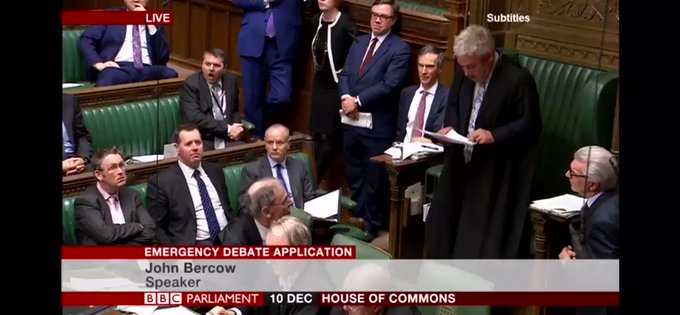
The gold ceremonial mace which is carried into the House of Common’s debating chamber each day was wielded in the chamber Monday evening, as tempers frayed over Britain’s withdrawal from the European Union.  The Member of Parliament for Brighton, one of the United Kingdom’s most clearly left-progressive cities, Lloyd Russell-Moyle marched up the centre of the chamber and took the golden mace from the table, before holding it aloft and walking towards the exit.

Speaker of the House John Bercow, who is responsible for the proceedings of the chamber and has the power to punish members for unruly conduct, was seemingly taken aback by the move by Russell-Moyle.  Bercow repeated the word “no” until the mace was taken off Russell-Moyle by a uniformed usher, who ceremoniously returned the item back to the chamber.  Bercow then ordered Russell-Moyle out of the chamber, barring him from the rest of the day’s sitting — which was already close to completion.


Embedded video

BREAKING: Utterly extraordinary scenes as Lloyd Russell-Moyle MP is expelled from the House of Commons after grabbing the Mace.
4:01 PM - Dec 10, 2018

Here is the chaser:

The mace is a gold-gilded silver symbol of the monarch’s authority in Parliament, and without it, the house cannot sit.  The mace has been seized on a handful of occasions in history, including during the English Civil War, and more recently by Michael Hesseltine in 1976. 
Such drama!  Such theatre! Such fun!