Showing posts with label Pacifism. Show all posts

Monday, 29 January 2018

Progressive Blindness

Hitler's a Good Chap

We have been re-reading in recent days the diplomatic interactions between Herr Hitler and the British, just prior to the commencement of World War II.  Of course, hindsight is always 20-20 vision.  Things seem so obvious, clear, and plain now.

The numerous interactions with Hitler amongst the British leadership were grounded in a grand presumption: Hitler, it was assumed,  shared  the same basic mindset as all European leaders.  Much of the interaction at top diplomatic levels reinforced the British conclusion that Hitler was "one of us".  He was a man who could be reasoned with on universal common ground.  Progressivist, pacifist ideology spurred them all on in a willing suspension of disbelief.

Friday, 24 November 2017

Clutching At Paper Straws

What Do Soros and Merkel Have in Common With Neville Chamberlain?

"See no evil, hear no evil".  So much of the West's response to Islam falls under this rubric.  Why has a generation appeared which is fixated upon overlooking what is obvious: Islam is a violent religion.  One reason would be that there are few in the West who have bothered to read the Koran--Islam's holy book.  Another is that Islamic violence does not fit in with the myths of humanism.  It is necessary for the maintenance of those myths that Islamic believers be regarded as "just like us" and if treated in a humanitarian, humanist manner they will quickly become both both humanitarian and Western (there is fundamentally no distinction between the two).

Secondly, there is a Marxist overtone that Western elites want to impose.  As part of humanist dogma, national governments are subject to nationalism--which, we are told--plays to ignorant, nativist fears, prejudices, and divisions amongst men.  Internationalism, however, escapes from such prejudices.  It looks with fondness upon mankind as a species, in the abstract.  When a human being is properly supplied with redistributed wealth all of the ignorance, nativist fears, and prejudices will fade away.  Islamic violence, we are told, is a hangover from days of tribalism and nationalist excess.  When properly exposed to humanism, and removed from nationalism, the Islamic believer will thankfully and willingly sign up to Humanist Manifestos I, II, and III.

As a consequence, most Western humanists operate in a cone of naive myopia.  They are like Neville Chamberlain in the run up to World War II.  His pacifism required, not only that he not give due recognition to Nazi nationalism, but that he act towards the Nazi's and Hitler according to the principles of his pacifist beliefs.  He was a significant contributing factor to Hitler's rise and domination of the German armed forcesy.  "Peace in our time" became the absurd myth driving Chamberlain's diplomatic dealings with Hitler.  Angela Merkel and George Soros fall into this kind of folly.  They (along with many others) are the Chamberlains of our age.  When it comes to Islam they are determined neither to see, nor hear, evil. 

Meanwhile, reality is starkly different.

Thursday, 26 November 2015

Pacifism's Contemporary Step-Child

 Every Form of Unfair Attack

In the mid-thirties, Germany was rapidly re-arming--in clear breach of the Treaty of Versailles.  Britain, however, was caught in a malaise of pacifism and anti-war sentiment.  It refused to see the growing elephant in the room.

Winston Churchill was one of the few MP's who devoted this part of his career to crying, "Wolf".  He warned consistently of the dangers, and urged a much greater commitment to defence spending.  He was mocked and pilloried in public, if not private.  To this day it is remarkable to reflect on the indomitable spirit which enabled him to persevere and persist.  Such conviction and moral courage over matters of public policy are rarely seen.

Finally, the House of Commons began to wake up to what was happening in Germany.  It decided to increase spending on the Royal Air Force.  When Churchill stood up to speak in favour of the measure, he warned the House of the inevitable vociferous reaction of the disarmament and pacifist elements of UK society.  He warned the members of the torrent of abuse which would be unleashed upon them.  Even now it is difficult to conceive the strength and power of idealistic pacifism which held the Britain in its grip at the time.

Warned Churchill:

Tuesday, 24 November 2015

Acolades From Old Friends

Sinking to the Occasion

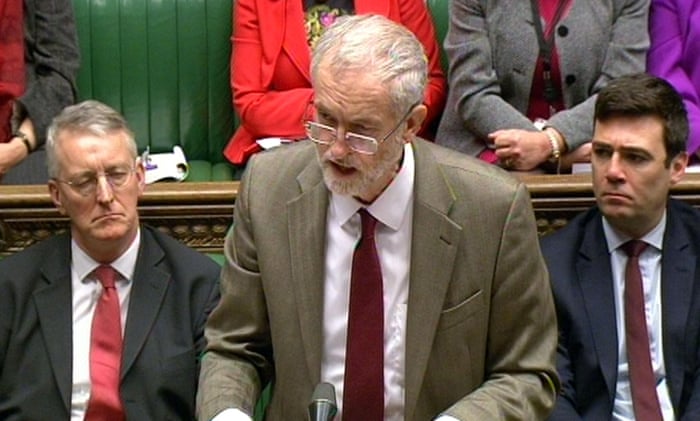
Spare a thought for poor Jeremy Corbyn.  We take no pleasure in his humiliation.  What humiliation, you ask.  He has been gravely shamed not just by his own party, but by columnists in his own newspaper, The Guardian which has decided that Corbyn is a bridge too far.

It's a bit unfair really, since the Labour Party has historically been led by deep sea divers catapaulting into the pool of pacifism.  Jeremy is merely diving in after the example of his greater forbears.  Now he is being mocked by his own--or what he thought were his own.

The Guardian calls Jeremy a "lonely figure" in the House of Commons:

Labour MPs back their leader … David Cameron

Jeremy Corbyn cut a lonely figure in the Commons as his party appeared keen to distance itself from man whose pacifism is out of step with the public mood


Jeremy Corbyn: the kind of leader who would politely request a terrorist to sit down for a nice cup of tea and talk through his anger issues? Photograph: PA

Jeremy Corbyn may have misgivings about shoot to kill, but few of his own MPs seem to share them. Sitting next to the leader of the opposition for the prime minister’s statement on the G20 summit and the Paris attacks was Hilary Benn. The normally mild-mannered shadow foreign secretary gave every impression he was trying to eliminate his boss with mind control and a rictus smile. Disappointed to find Jezza still breathing, he left without saying goodbye after 45 minutes.

Other Labour MPs chose to kill their leader by vocalising their whole-hearted support for the prime minister’s tougher stance on terrorism. One by one they rose. Pat McFadden. Mike Gapes. David Hanson. Chris Leslie. Emma Reynolds. Chuka Umunna. Anne Coffey. Ian Leslie. Even the usually on-message Sarah Champion. Et tu, Sarah? There would have been more, had not the Speaker curtailed the debate. Not even in Iain Duncan Smith’s darkest hours had a leader been turned on so openly by his own party in parliament.

Gravitas isn’t something that comes easily to David Cameron but, just this once, he was allowed the chance to feel what it might be like to be a statesman. A father not just to the Conservatives but also to a Labour party keen to distance itself from a leader whose pacifism has failed to capture the public mood. A father to the nation.

Having begun the session in low-key deferential fashion, promising to take due note of the foreign affairs select committee’s concerns before embarking on military action in Syria, the prime minister was almost in the mood to start the bombing immediately by the end. Such was the universal hawkish acclaim he was receiving. “We’ve got better weapons than the US,” he boasted. “We’ve got the Brimstone missile that can take out jihadis just like that.”

For Corbyn, it was more a case of sinking to the occasion. In recent exchanges with the prime minister, the Labour leader has more than held his own but now he was hesitant, stumbling over his speech long before many of the poisoned arrows had struck him. “Um ... er,” he said, coughing nervously and regularly losing his place and train of thought.

What would successful military action look like? Is bombing a country into rubble the best way of building a new democracy? These important questions went almost unheard. After his remarks to the BBC on Monday, Jezza is finding it hard to shake the impression that he is the kind of leader who would politely request a terrorist to sit down for a nice cup of tea and talk through his anger issues, even as he was reloading his AK-47 to gun down some more civilians having a quiet night out.

The onslaught took its toll. Minister after minister abandoned Corbyn on the frontbench until the only people left were Diane Abbott and a totally bewildered Barry Gardiner, a junior shadow minister for climate change. Having got up most of her colleagues’ noses by catching up with her correspondence at a meeting of the parliamentary Labour party the night before, it was too early for Abbott to start on her Christmas cards. So she just stared stony-faced into the abyss. What she saw was too frightening even for her, so she too upped sticks. Though not before roping in a reluctant Jon Trickett to take her place.

Gardiner passed the time by ostentatiously tapping away at his iPad. A tip, Barry. Passive-aggression has never been a worthwhile tactic when playing Call of Duty. He nudged Corbyn to let him know the baddies had just killed him for the umpteenth time in a row before he had had a chance to save his game at the checkpoint. Jezza knew the feeling. Shoot to kill had just claimed its first parliamentary victim.

Thursday, 9 July 2015

What Is Our Policy?

Survival

The period between the First and Second World War in the UK has been dubbed the "Twilight Years"  by celebrated historians.  The country was awash with communist and latterly national socialist sympathisers, with pacifists, with Fabian socialists, with academics entranced by Freudianism, and with eugenicists.  [See Richard Overy,  The Twilight Years: The Paradox of Britain Between the Wars (New York: Penguin/Viking, 2009)]

The pacifist sentiment was largely represented politically via the Labour and Liberal parties.  But not exclusively so.  Neville Chamberlain, the architect of the foreign policy of appeasement towards Hitler, professed to be a pacifist.  He led the Conservative Party.  But despite the grip of these strange philosophies and teachings, when it finally became clear to the wilfully obtuse that Herr Hitler was an aggressor and had an ambition to rule Britain by force, the nation and its intellectuals and false prophets came together as one.

When Chamberlain realised that Hitler had deliberately deceived and lied to him, he became resolute in leading the nation in war.  But he was unable to win the universal support of the House of Commons.  Eventually, Winston Churchill was asked to lead a coalition government representing all parties in the House.  Repentant pacifists stood to indicate their support.  All parties laid aside politicking and began to pull together in harness to defend the nation.

Winston Churchill describes the moment:

Thursday, 2 April 2015

Diabolical Advice

Fashionable Idolatry

Patriotism is a dangerous narcotic.  So is nationalism.  As are all the fashionable causes of our day.  

C. S. Lewis’s diabolical advice in Screwtape Letters, chapter 7 (emphasis added) explains how and why:
Let him begin by treating the Patriotism or the Pacifism as a part of his religion.
Then let him, under the influence of partisan spirit, come to regard it as the most important part.

Then quietly and gradually nurse him on to the stage at which the religion becomes merely part of the “cause”, in which Christianity is valued chiefly because of the excellent arguments it can produce in favour of the British war-effort or of Pacifism.

The attitude which you want to guard against is that in which temporal affairs are treated primarily as material for obedience.

Once you have made the World an end, and faith a means, you have almost won your man, and it makes very little difference what kind of worldly end he is pursuing.

Provided that meetings, pamphlets, policies, movements, causes, and crusades, matter more to him than prayers and sacraments and charity, he is ours—and the more “religious” (on those terms) the more securely ours. I could show you a pretty cageful down here.
Justin Taylor
HT: Warren Throckmorten

Monday, 7 October 2013

Marketing

Oh What a Lovely War

In 2012 the UK Ministry of Defence produced a paper giving advice on how to "market" war to the public.  The intention was to work out how to increase public support for the various wars the UK was engaged in at the time.  One suggestion made was to make less of repatriation and funeral ceremonies of those who had died.  Downplay the negative.  Accentuate the positive.  That sort of stuff.  Typical marketing fluff.
The document, written in November 2012 and obtained by the Guardian under the Freedom of Information Act, discusses how public reaction to casualties can be influenced and recommends that the armed forces should have "a clear and constant information campaign in order to influence the major areas of press and public opinion". (The Guardian)
The folk don't like hearing and seeing that soldiers and airmen have been killed.  It is a negative.  It ought to be downplayed.  Don't regard these people as heroes who have laid down their lives for the protection of their loved ones, their neighbours, and their nation.   That ends up accentuating the negative, which will reduce "market" appetite and demand for war.

But wait a minute.  This is war we are talking about.