Showing posts with label Constitution. Show all posts

Tuesday, 26 December 2017

Understanding The Times

Timing is Everything--They Say

Here is an excellent summary of a key aspect of English constitutional development.  
We like to think that liberty is fought for.  Judging by occasional comments in the media and by politicians, a widespread belief is that liberty was won during the [English] Civil War.  The reality is different: the war almost destroyed liberty.  Only when the country rejected fighting, and zealots had to abandon their visions of a compulsory New Jerusalem, was liberty possible.

To the Whigs we owe the principle--Magna Carta restated in modern form--that rulers must obey the law and that legitimate authority requires the consent of the people.  From the Tories came the principle--fundamental to any political order--that people have no right to rebel against a government because they disagree with it.  
Combining these seemingly conflicting principles produced characteristics of English political culture:
suspicion of Utopias and zealots; trust in common sense and experience; respect for tradition; preference for gradual change; and the view that "compromise" is victory, not betrayal.

Thursday, 8 October 2015

Lawful Christian Resistance, Part V

The Consent of the Governed A Biblical Pattern

All students of political philosophy know there is a connection between limited government and the doctrines of checks and balances.  No king, or president, or governor has absolute power; the power of all is limited.  The power of all ruling institutions is checked and balanced by other institutions and authorities.  Herein lies the essence of liberty, on the one hand, and the deconstruction of absolutism, on the other.

These fundamental precepts upon which life, liberty, and the pursuit of happiness depend, arise out of ancient traditions.  In particular, we are confident that they arise out of Christian and proto-Christian civilisation.  The more a nation or civilisation turns away from acknowledging Christ as the King of kings, the more rapidly it will destroy liberty and descend into anarchy or an absolutist tyranny.

The essentials of the doctrine of limited, multiple authorities are found in the constitution of ancient Israel itself.  David was God's anointed king-to-be. God had chosen him, anointed him, and called him to be His king over all Israel.  David, therefore, had a divine right to rule.  But, actually, he did not, as the inspired record makes clear.  He had a divine calling, but not a divine right.

Saturday, 4 April 2015

Douglas Wilson's Letter From Moscow

Three Senators and a Leper

Douglas Wilson

One of our great cultural problems today is that Christians do not understand civics. And by civics, I do not mean the “how a bill becomes a law” kind of civics, but rather I refer to our very common misunderstanding of the true nature of our appointed government. We have a particular form of government de jure, laid out for us in the Constitution, and we have another, very different, form of government, de facto, sitting atop Lady Liberty, strangling her to death.

Too many Christians, not wanting trouble, just blithely assume that whatever the Feds are doing is “more or less” in accord with the Constitution. There may be encroachments here or there, they think, but in the main things are okay. They further believe that our duty outlined for us in Romans 13 requires us not to look too closely at it.

Actually, it is the reverse. Our responsibility is found in Romans 13, but it requires us to look at this far more closely than we are accustomed to do.

It is not the case that the Federal government simply outranks local officials, the way (we think) a king outranks a duke. In a government of law, the king outranks all others in his appointed duties, and a duke outranks all others in his appointed duties. This is how separation of powers works.

“But when he was strong, his heart was lifted up to his destruction: for he transgressed against the Lord his God, and went into the temple of the Lord to burn incense upon the altar of incense. And Azariah the priest went in after him, and with him fourscore priests of the Lord, that were valiant men: And they withstood Uzziah the king, and said unto him, It appertaineth not unto thee, Uzziah, to burn incense unto the Lord, but to the priests the sons of Aaron, that are consecrated to burn incense: go out of the sanctuary; for thou hast trespassed; neither shall it be for thine honour from the Lord God” (2 Chron. 26:16–18).

So, simple question. Does a king outrank a priest?

Saturday, 2 February 2013

Treaty of Waitangi Fables, Part III

Tribalism Makes Some Animals More Equal Than Most

This is the third piece recently seeing the light of day in the NZ Herald confronting the historical revisionism being foisted upon the Treaty of Waitangi and its signing.   Dr Elizabeth Rata takes up the issue of Maori tribalism and argues that it is incompatible with a democratic form of government.

Elizabeth Rata: Tribalism, democracy incompatible

5:30 AM Tuesday Jan 29, 2013

Tribalism is based on principles of inequality. Democracy is based on equality. So unity is only way forward.
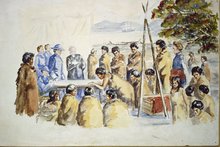
The post-1987 idea of a Treaty 'partnership' is not true to the original Treaty.  Photo / Alexander Turnbull Library
The post-1987 idea of a Treaty 'partnership' is not true to the original Treaty. Photo / Alexander Turnbull Library


The recent Herald commentary by Ewen McQueen takes us further into a thoughtful consideration of the Treaty of Waitangi and the constitution. Using Sir Joseph Ward's metaphor that "there can only be one sun in the sky", McQueen showed why the post-1987 idea of a Treaty "partnership" is not true to the original Treaty. He concluded by noting that most chiefs agreed to give absolutely to the Queen the complete government over their land in return for guaranteed protection of chieftainship.

Saturday, 29 December 2012

Poisonous Green Shoots

The Egyptian Spring Unveiled

Constitutions of nation states serve as the highest, or entrenched law of the land.  The constitution cannot be discarded or changed by an act of Parliament or Congress.  Rather, the legislative and executive and judicial branches of government are bound by the precepts and governing arrangements laid out in a constitution.

In order to function effectively as a limit to state power and a protector of the civil rights of subjects, the governing powers and the law courts need to submit themselves to the constitution.  The ultimate defender and enforcer of sanctions upon those who violate a constitution is "we the people".  It is for this reason that the recently adopted Egyptian constitution will be an abject failure.  In the plebiscite held to adopt the constitution, 60 percent approved it, but only 30 percent voted which implies that the brand new Egyptian constitution enjoys not more than 18 percent national support.

The Egyptian constitution, then, is an irrelevance.

Wednesday, 19 December 2012

Revolution by Stealth

Divisive Politics; Destructive Outcomes

In a recent hearing at the High Court the attempt by the Maori Council and Tainui to get a court judgment that Maori have de facto proprietary rights over water by virtue of being Maori was rejected.  No doubt Maori will pursue the case to the Supreme Court.  The way the case played was interesting. 

Justice Young found (amongst other things) that the Government (which the Maori Council was seeking a judgment against) had been acting according to the law of the land.  Here is a key part of the judgment:

No review of Parliament by the Courts is permitted in law. This is effectively what the claimants have asked this Court to do in these proceedings.
That particular statement goes to the heart of a matter which has been festering in New Zealand for years.  Maori have told themselves, and persuaded many others, they they have authority and mana which is equal to that of Parliament.  This is the implicit consequence of claiming that Maori, as signatories to the Treaty of Waitangi, are Treaty Partners or co-Regents with the Crown. 

There are two kinds of treaties.

Tuesday, 27 November 2012

Long Live the Revolution

 Egyptian Progress

The hot air expended by President Obama's to express thanks and congratulations to President Morsi of Egypt for his stirling work at achieving a cease fire in Gaza had barely dissipated when the same said Egyptian president awarded himself dictatorial powers.  Nice one, Mohammed.

There are two ways the West will respond to this inevitable lurch toward totalitarianism in Egypt.  The first will be to "Mubarakise" Morsi.  The West has had common cause with tyrants and authoritarian dictators in the Middle East for well nigh a hundred years.  It has "overlooked" one or two lapses of niceties in places like Saudi Arabia, Iran, and Egypt so long as these dictators helped advance the global aspirations of Western ideological zealots in their vain attempt to lead the world to salvation.  Consequently, we expect Western nations to agree that President Morsi is a helpful and constructive leader who can be an ally in bringing peace and stability to the Middle East.

The second response will be to see betrayal in Morsi's abrupt termination of Egypt's move towards democracy.

Friday, 13 July 2012

Douglas Wilson's Letter From America

Nullification or Nutterfication? 

Culture and Politics - Obama Nation Building
Written by Douglas Wilson
Tuesday, 10 July 2012

If your kayak is going over the falls, then the mainstream is the last place you would want to be. I say this because "mainstream" is not automatically a term of praise. At the same time, nobody wants to be a nutter just for grins, and so allow me to lay down some basic principles of Christian resistance to the kind of soft despotism we are up against.

By "soft" despotism, incidentally, I am talking about style, not results. Brave New World was every bit as hard and coercive as 1984, but soma was more fun for the recipient than having a jackboot in your face. Liberty is just as gone in either case. Sometimes hard seems hard, and sometimes it doesn't. But it always is hard.

Thursday, 2 February 2012

Douglas Wilson's Letter From America

Honest As White Paint

Mere Christendom
Written by Douglas Wilson
Friday, January 27, 2012

I have said kind things about Ron Paul in the past, and I will continue say them in the future. He continues to be one of the people I could vote for when Ringling Bros. finally brings the gaudy parade to my state. But he whiffed it last night in the debate when asked how his faith would affect his behavior in office. He said that it wouldn't. Not only did he whiff it, but Santorum jacked it out of the park.

Santorum said, quite rightly, that the Constitution is the how of America, and the Declaration is the why. He said that government doesn't give us our rights -- God does that -- and he said that the government's role is to protect God-given rights. This was a dead-on bull's eye.

Monday, 28 November 2011

Expect Self-Interest to Emerge Full Blown

We Can Trust the Pollies to Get It Right

There will be a brief flurry of interest in the Referendum held on the 26th November, 2011 as the votes are counted and the results come in.  It would seem that the public favours keeping Mixed Member Proportional Representation and giving the politicians the opportunity to tweak it.

We think it timely to remind ourselves that our system of MMP reproduces the German system.  No system is perfect; the MMP system--with all its quirks and frustrations--has worked reasonably well.  Its faults are well known.  But now the MP's will get to tweak it and make it better.  We now enter a potentially dangerous phase.

Tuesday, 5 July 2011

Douglas Wilson's Letter From America

Not Entirely Gone

Liturgy and Worship - Exhortation
Written by Douglas Wilson
Saturday, July 02, 2011

As you know, tomorrow is the 4th of July. This is the day on which we as Americans commemorate our independence from the tyranny that was being driven by the Parliament of England, but which was allowed by the king—who was constitutionally bound to protect us from all such usurpations. Because he failed in this fundamental constitutional duty, we no longer owed him our constitutional allegiance.

Now that declaration of independence had particular political details tangled up with it, tied to that time and place. Now I trust that when you set off your fireworks tomorrow night, you will teach your children to shout, “Down with the House of Hanover!” At the same time, the House of Hanover is not the present threat.

Thursday, 2 June 2011

Doug Wilson's Letter From America

An Inept Farmer With a Dull Knife

Culture and Politics - Politics
Written by Douglas Wilson
Friday, May 27, 2011

The (US) Constitution was the work of a corporate body, and that corporate body had different men and various factions in it. The Constitution was ratified by 13 states (eventually), but only with the proviso that the Bill of Rights be attached to it. These states ratified with varying degrees of enthusiasum and/or nervousness. And so we cannot say, "The Constitution was . . ." without adding a clause indicating what it was to whom.

The Federalists wanted to ratify the Constitution the way it came out of the convention. The Anti-federalists didn't want to. Under pressure from the Anti-federalists, who had a lot of good arguments, the Bill of Rights was added. This means that the Constitution, as it was adopted, was a moderate Anti-federalist document. The Tenth Amendment made it staunchly Anti-federalist. The moderation came in because there were Anti-federalists who believed that language like that found in the Tenth Amendment was explicit and clear enough not to get somehow ignored. The event has shown that this optimistic take was wrong.

Sunday, 1 May 2011

Sideshows

The House of Windsor and Decks of Cards

Political theorists of the Reformation argued that there was nothing intrinsically evil about the regimen of kings. Unlike the radical Thomas Paine, who argued vociferously in his incendiary pamphlet The Rights of Man that monarchs had been responsible for just about every tyranny every conceived, the faithful knew better. The Reformers understood that the Church had subsisted under a variety of forms of civil government: autocracies, monarchies, tribalism, and imperial domains. They also believed that the Church's form of government was to be republican--government by elders, approved by the people and ordained by God. This divine form of government was revealed in Holy Scripture.

The application of the ecclesiastical pattern of government to civil government was appropriate, but was not mandatory. What mattered was whether the civil government was firstly a government of law, and secondly whether the law reflected the law of God Himself. This was the thrust of Samuel Rutherford's Lex Rex. Take the matter of marriage. It mattered little whether marriage and family law was promulgated by a king or a council; what really mattered was whether marital law reflected the teachings of the Bible on the matter.

The marriage of Cate and William Wales has stirred up the debate over the monarchy again--and whether New Zealand should become a republic. We note that royalist sentiment is stronger here now than when Charles and Diana were defaming the House of Windsor. The same is reportedly true in Australia.

To us the issue is insignificant--a distraction, even. New Zealand is one of the few countries in the world with a unicameral parliamentary system. Laws can get promulgated relatively easily here. There are few formal divisions of power, and checks and balances. The most effective restraint we have upon tyrannical and arbitrary power is the smallness of the country. The machinations of political masters are easily exposed and their cloaks threadbare. Politicians in New Zealand are relatively naked. The monarchy is not an effective check and balance upon other branches or organs of government.

Even if it were, it would matter little. Both the UK and New Zealand long ago adopted Western Unbelief as the established religion. Secularism with its attendant humanism is dominant. Regardless of the form of government--republican or constitutional monarchy--the laws of our land conform relentlessly to this higher creed. The hearts of our rulers and the hearts of our people reject God and approbate Man. Whilst the law remains a minor potentate, it is subject to the regimen of Unbelievers writing the law to satiate their lusts and desires.

The constitutional forms of civil government at this point are a small matter.

Friday, 7 January 2011

A Living Constitution

Words That Matter

There is a right-royal brouhaha in the United States at the moment--at least amongst the liberal elites.  It has been provoked by the newly elected Republican majority in the Congress, which has determined it will begin by a formal reading of the Constitution to the House  (Most Democrats refused to attend.)  This is one of those debates that divide and so is of interest to any who think seriously about the legitimate role of civil government in a free society.

To be sure there are those in the United States who have made an idol of the US Constitution, wanting to endow it with infallibility and the status of a demigod, just as there are those who want to rip the thing up and consign it to the dustbin of history.  These represent the extreme fringes of the debate and thus need not concern us. 

The positions of the "mainstream" protagonists can be neatly summarised.  Firstly, there is the editorial writer of the New York Times who sneers at the waste of time and money, and empty symbolism of having the  Constitution read to the House. 
Those who had hoped to see a glimpse of the much-advertised Republican plan to revive the economy and put Americans back to work will have to wait at least until party leaders finish their Beltway insider ritual of self-glorification. Then, they may find time for governing.
The empty gestures are officially intended to set a new tone in Washington, to demonstrate — presumably to the Republicans’ Tea Party supporters — that things are about to be done very differently. But it is far from clear what message is being sent by, for instance, reading aloud the nation’s foundational document. Is this group of Republicans really trying to suggest that they care more deeply about the Constitution than anyone else and will follow it more closely?
Dear me.  Tut, tut.  But the substantial argument for the legitimacy and place of the Constitution is made obliquely in the next paragraph:
In any case, it is a presumptuous and self-righteous act, suggesting that they alone understand the true meaning of a text that the founders wisely left open to generations of reinterpretation. (Emphasis, ours)
In this view, the Constitution is a beginning, not an end. "Reinterpretation" implies changing the meaning thereof.  It needs to be reinterpreted with each succeeding generation, to keep it alive and relevant.  Beneath this lies an ossuary of suppressed premises.  Amongst these are:

1. It is illegitimate for previous generations to bind and control the present generation.
2. Continuity of meaning over time of a particular text (book, essay, letter) is impossible.
3. Relevance cannot be sustained and maintained intergenerationally.
4. Truth and meaning evolve and change over time.
5. To survive requires change and adaptation.
6. Life comes from the existential now.

This view of the Constitution is the "mainstream" progressive perspective.  It leads to legislators and the Executive ignoring the limits on civil government imposed by the Constitution, on the one hand, and activist judges who discover new, previously unheard of  "constitutional rights" in every bedroom and washroom in the country.  In a word, it has led to a relentless expansion of power by the civil government--which pretty much sums up the last two hundred years of Western history. 

The contrary position is succinctly put by US Supreme Court justice, Antonin Scalia in the following video.


This position, too, has many suppressed premises--the opposite of those listed above.  What is really interesting is that these are the same issues that have dogged Christ's Kingdom for two thousand years.  Moreover, it is impossible to take a definitive position on this debate without grounding it biblically and theologically. 

Because the Christian Gospel believes in the all governing, all conditioning God, Who does not change, continuity through development and despite change is not only possible, it is inevitable.  Because Christ is King and Lord over all the nations of the earth, and has been for over two thousand years, all the contingencies, all the developments, all the change has already been anticipated, accommodated and sufficiently addressed in His Word.  This means that the Bible remains infallible and sufficient.  Whilst TV's and the Internet had not been invented, and the United States did not yet exist whilst our Lord was upon earth, their eventual reification was already anticipated and has been sufficiently addressed in Holy Scripture.  (II Timothy 3: 16,17) Thus the Word of God remains perpetually authoritative and pervasively relevant  to each generation--but only because of the totalitarian governance of our Lord Jesus Christ over the entirety of human history, so that no contingency is brute or unplanned or unordained.  Every decision of the cast lot is of the Lord.  (Proverbs 16:33)


If a society believes this, then authoritative documents binding successive generations are not only possible, but essential.  For the Lord has commanded us to learn from our forbears what He has already taught them.  (I Corinthians 11:2; II Timothy 2:2).  It is inevitable that subordinate standards emerge and are accepted--standards that are subordinate to the Word of God, that derive their authority from it, but are neither themselves  inspired, nor infallible.  Whilst capable of modification and adjustment and development, their higher authority depends not upon continual adjustment, but upon the Word whence they are derived.

For a society to remain Christian, it must not only have such subordinate standards, but they must be entrenched and not subject to the popular or elitist will du jour.  This is what the very foundations of constitutional government are themselves built upon.  But without the "deeper Magic" of the Word of God, they will soon crumble into desuetude.  Which is what is happening now in the United States and, as we have already noted, across the entire Western world. 

But the prerogatives of Power do not disappear under this revolution: they get transferred by man from Christ to the State, and therein lies the seed and root of the divine judgement which will inevitably fall until we repent.  For our Lord is a jealous God and He will not give His glory to another--which is to say, to the creature. 

We agree with the progressive liberals.  All subordinate standards in a community must be living documents and living words.  The issue is whence the spirit and life come.  But for the liberal the quickening of all things, including foundational documents, comes from us, from humanity.  For the Christian, the quickening of all things comes from the One who lives and abides forever and to Whom has been granted all power and authority in the heavens and upon the earth.  

Patterico makes a historical and "common sense" argument for the Constitution as an authoritative subordinate standard.  But in our world, it strangely fails to compel.  Why?  Because the argument below is only compelling upon overt, explicit Christian foundations. 
These twin concepts, of original understanding and textualism, are not mere legal theories. They are the underpinning of the legitimacy of our government. The People of the various states did not surrender powers whose contours were to be decided by judges who substituted their own “evolving standards of decency” for the text. Nor did they surrender powers to be determined by the unexpressed will of any particular founder or group of founders. They surrendered powers — limited powers — according to a text, the meaning of which is fixed in the words of the document, and determined by the original understanding of those words. The only legitimate way that our Congress can exercise power is by adhering to that text.
It is an absolutely essential idea, therefore, for a Republican Congress that actually intends to exercise power in a legitimate fashion, to begin its session by reading the very text that delineates and circumscribes its legitimate authority.
The proof of the pudding is, of course, in what this Congress does — not in mere symbols. But symbols matter too — and this is a hell of a symbolic statement with which to open.
UPDATE: Ilya Somin says it well in an old post:
The idea that the law is ultimately embodied in the text enacted by the legislature rather than in the subjective “purposes” of the legislators strikes many people as just common sense.
Indeed. And since we are a nation founded on the rule of law, we are a nation governed by texts, not subjective purposes or intent. This, again, is why reading the text is so important — and why reading the text of our most important document is a crucial reminder of what it says — and what (despite liberals’ fondest hopes) it doesn’t say.
Patterico is right and the argument is both compelling and sound, but only if we give up the suppressed premises of progressive liberalism and reject the false religion upon which they are based.  Unless we have Christ enthroned in our lives and communities, we are all progressive liberals at heart.  "Turn back, turn back from your evil ways, for why will you die, O house of Israel? (Ezekiel 33:11)

Tuesday, 19 October 2010

PM Midterm Report Card, Part III

Flawed Constitutional Instincts

In this report card on the current Prime Minister of New Zealand, John Key we employ the word "instincts" frequently. Instincts can be salutary where they function as early and leading indicators. But instincts, whilst necessary, are never sufficient. They must be buttressed with principled thought. It is here that one of John Key's biggest flaws becomes apparent. He often betrays a want of fundamental principles to inform clear thinking to support his instincts. The upshot is that he ends up as a milk-toast, weak kneed, unprincipled leader who consistently kow tows to the left or the social progressives (aka, the velvet revolutionaries).

This leads people to sense that there is a shallowness to the current Prime Minister. Some have averred that he trades too much on being a "nice guy". Others have complained that he is a weak and plastic man. Whilst they concede he may well be a nice guy, he is clearly not a leader.

So, his constitutional instincts appear sound. He clearly does not regard government as his own personal fiefdom. He has reversed the previous government's deliberate politicising of the public service--a terrible travesty of the constitution. He has stopped dead in its tracks the revolutionary attempt by the Labour Government to override the neutrality and impartiality of the electoral process, which resulted in never-before-seen curtailments of freedom of political speech. It would be hard to imagine John Key stripping away the Privy Council as the highest court in the land, without careful consideration and a broad political consensus. One has not seen deliberate attempts to stack the judiciary with party activists and flunkies that occurred under Justice Minister, Margaret Wilson. The recovery of a neutral Speaker's Chair in Parliament has been immensely gratifying--and to the good of all.

All these can be cited as evidence of Key's sound constitutional instincts--and this soundness is neither inconsequential nor unimportant. We are very thankful for it. So, a bouquet is arguable.

But Key's instincts do not appear to be buttressed by a grasp of principle. Two examples illustrate what we mean. The first is his willingness to play a condign role in the most radical change in the constitution and the rule of law in this country. We refer, of course, to the claim of co-sovereignty by Maori over the country. This is a radical constitutional claim--and by now the soft-revolution is virtually "all over, Rover".

Key initially took a stance that appeared quite principled. He committed himself and his party to the abolition of Maori seats. That was a sound instinct. But underneath it lay an iceberg of broader constitutional issues to which he appears completely oblivious, or, worse, has decided are relatively unimportant in the bigger scheme of things.

Much has been made about the Treaty of Waitangi. Up until about thirty years ago it was universally held that the Treaty was a "vassal treaty" in which Maori ceded sovereignty to the Crown. Now "vassal treaties" or covenants have been around since the beginning of time. But Maori have gradually worked up an argument to re-write history and the exegesis of the Treaty. We believe they have done so dishonestly, using this argument as a pretext for yet more state sanctioned redistribution of others property to Maori.

Maori have argued essentially two things about the Treaty. First, because it was entered into voluntarily and not by subjugation, it can also be exited voluntarily. Like a modern, secular "marriage", whilst the parties freely enter into the arrangement, it can be broken and revoked at by one of the parties at will. Thus, they have argued, Waitangi was not a vassal treaty, and therefore sovereignty by Maori to the Crown was not conceded. It was a Treaty between equals.

Secondly, and following on from this, Maori have argued that they are "Treaty partners" and therefore share co-sovereignty over the nation with the Crown. Just as Maori ceded sovereignty to the Crown when they signed the Treaty, the Crown equally ceded its sovereignty to Maori.

It goes without saying that this is a completely radical and revolutionary conception. It is historicism on a grand scale. But, amazingly--and to our everlasting shame as a nation--it has been widely accepted by default. It remains unchallenged and uncontested. It is a radical reshaping of our Constitution. John Key has failed to grasp this.

So, he has approached the whole Maori political movement (as expressed via the organ of the Maori Party), as a negotiation, a deal to be had. Now a deal to be had in politics is one thing. But when it involves a fundamental change in our constitutional fabric, it is something else entirely.

John Key has failed the country badly here. He has been in an ideal position--he has had an opportunity that will possibly never happen again. Upon going into coalition with the Maori Party, he has had the opportunity to concede the abolition of the Maori parliamentary seats for the time being, whilst reiterating constantly the wider constitutional issues and that are at stake. This he has failed to do. The spurious claims of co-sovereignty, withdrawal from the ceding to the Crown, and of "Treaty partner" have to be named and shamed. Key has defalcated on these responsibilities. Once the Maori Party was in the tent he was in a perfect position, privately and publicly, to press the fundamental constitutional issues at stake, and reject the revolutionary historical revisionism which Maori and progressives have been successfully foisting to date upon the country. On all these matters, Key has gone cacophonously silent. One is left wondering whether he really understands the issues at all.

A second example of egregious constitutional failure has been Key's position over the anti-smacking law. He has stubbornly, in the face of overwhelming public opposition, clung to his maxim that he will not support a law amendment unless damage is done to "ordinary" New Zealand families. He has "assured" the country that despite what the Crimes Act now says, he will ensure that the Police will exercise discretion and not apply the law, at least not in the way it is written. This is a totally untenable position from a principled constitutional perspective. It tacitly and implicitly and in principle undermines the rule of law itself.

And why has he done this? We are told that Tariana Turia made a personal appeal to him not to amend the law because of the "message it would send" to Maori about child abuse. No doubt there was other pressure bought to bear upon Key from inside the Beltway as well. But if Key has been willing to set constitutional principles aside for the sake of maintaining "good guy" status with his coalition partners, he has failed in his duty as Prime Minister. There is no other conclusion that can be drawn.

On the matter of fidelity to the constitutional framework of New Zealand's Westminster democracy, we appreciate Key's instincts, but believe him to be way out of his depth. He is perpetuating recent damage, and has been inflicting his own, new harms.