Showing posts with label General Revelation. Show all posts

Friday, 17 October 2014

Douglas Wilson's Letter From Moscow

University-Trained Mole Rats

Douglas Wilson
October 10, 2014


Scripture teaches us that the creation is articulate.

“The heavens declare his righteousness, And all the people see his glory. Confounded be all they that serve graven images, That boast themselves of idols: Worship him, all ye gods” (Ps. 97:6–7).

The created order pours forth speech. Nature is not a dumb mute, vaguely gesturing in the direction of some nameless god, who must have made “all this.”

It is far more than that. The creation pours forth moral speech. In the text cited above we should note that the heavens declare God’s righteousness, and does so in a way that makes it unmistakeable that this righteousness is glorious, and that it humiliates those who pray to their statues. An honest look at the night sky, in other words, not only blows away the pretended rationality of idolatry, but also the pretended morality of it. The heavens declare God’s righteousness, and shames the unrighteousness of every alternative pretense.

Tuesday, 11 March 2014

Douglas Wilson's Letter From Moscow

Why Lies Digest So Well


As Flannery O’Connor put it, “The truth does not change according to our ability to stomach it.” But a falsehood, as Chesterton notes, is engineered precisely so that the listeners would in fact be able to stomach it. Stomachability is a design feature when it comes to a lie. Who would invent lies that nobody is going to want to believe?

But the truth simply is what it is.

This is why truth tellers are always troublemakers. And this is also why the postmodern heart loves the coherence view of truth, and detests the correspondence view of truth. The coherence view includes all those things that might be pleasant to digest, and the correspondence view encompasses the rest of the world, which is not really all that edible. It is measured by criteria other than how it might make us feel half an hour after dinner.

This is why, incidentally, C.S. Lewis is beloved by conservative American evangelicals even though he wasn’t one. He hated subjectivism, and saw that subjectivism was the portal through which every foul error makes its way into the lives of believers. It is the same portal, come to think of it, from which Rob Bell made his escape. The world is simply there, and we are the ones who must conform to it, and not the other way around.

Monday, 16 September 2013

Books

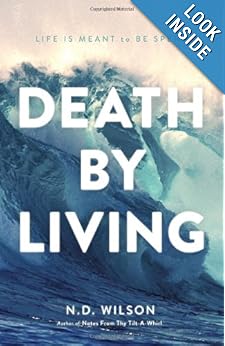
"Death by Living"

Life is meant to be spent. N D Wilson
[Thomas Nelson, 2013  208 pp., $19.99 ]

Book Review by John Wilson
Books and Culture

September 2013

Pardon me for quoting myself, but here is the way I started a book review for Christianity Today magazine in 2007: "Remember, you read it here first. N. D. Wilson (no relation, I hasten to add) is a name that will soon be widely known. He will write many books, Lord willing, in many genres for our instruction and delight. His first is Leepike Ridge (Random House)."

Six years later, and now in his mid-thirties, Wilson has already written a bunch of books, in several genres, not to mention a bit of screenwriting. His latest, Death by Living, is his second work of nonfiction and (so I think) his best book yet.
"This is a spoken world," Wilson writes—"from galaxies to inchworms, from seraphs to electrons to meter maids, every last thing was and is shaped ex nihilo. It—and we—all exist as beats and rhythms and rhymes in the cosmic and constant word art of the Creator God. To fully embrace and attempt to apply such a vision is … dizzying." The ellipses are his, and what he's attempting is not just dizzying, it's impossible—but it's worth trying, again and again, over the course of a lifetime.

Death by living? That's the fate we all share.

Saturday, 8 June 2013

Douglas Wilson's Letter From America

What Plato’s Cousin Knew 

Monday, June 3, 2013
Douglas Wilson 

Theological disputes are often matters of great moment, even when those outside the dispute cannot track with what is going on. I think it was Gibbon who once displayed his ignorance by saying that the debate over homousia and homoiousia was somehow over the letter i — which is pretty similar to saying the debate between atheists and theists is over the letter "a".

But at the same time, theologians are capable of talking past each other simply because they are used to different terminology, or perhaps because they are worried about the trajectory of those who use that other terminology. Take, for example, the distinction between natural revelation and natural law.

Now before opening this particular worm can, I want to acknowledge that two positions represented by these phrases can be quite different indeed. But this is a historical fact, not a logical one. I believe the two essential positions can be collapsed into one another with 5 minutes of questions.