Showing posts with label New Zealand Missionaries. Show all posts

Saturday, 9 November 2019

New Zealand's First Convert

Truth Or Falsehood

The first "official" convert to Christianity in New Zealand that we are aware of was a chief called Rangi.  He was tuberculous and dying.  The date was 1824; the location was the Bay of Islands.  The missionaries involved were Henry Williams and Richard Davis. 
There is record that he suffered quite severe symptoms in October 1824 and again in February 1825, but by July 1825 the disease took an even more serious turn and he suffered the rapid weight loss that gave tuberculosis its common name of "consumption". 

Despite his illness, on 7 August 1825 he made, in the language of Richard Davis, "an open confession of his faith in Christ in the presence of many of his Countrymen."  So, in the final stages of his illness, when his "bones stood through his skin", having had his faith "narrowly examined" and with the full consent of the other missionaries present, Rangi was baptised by Henry Williams and took the name Christian Rangi.  He died the next day. [Malcolm Falloon, "Christian Rangi: 'A Brand Plucked from the Burning"?,  Te Rongopai 1814: 'Takoto te pai!"  Bicentenary Reflections on Christian Beginnings and Developments in Aotearoa New Zealand. (Auckland: Anglican Church in Aotearoa, 2014),   p.130.]
Historian Malcolm Falloon quickly dismisses the paternalistic condescension of secularist historians by which Rangi's faith is rationalised into a naive act by a primitive, ignorant man.  He identifies four factors that played a role in Rangi's conversion and subsequent profession of faith.

Thursday, 27 June 2019

Broken Promises and a Breached Treaty

Henry Williams and the Treaty of Waitangi


"Behold I bring you good tidings of great joy". These words heralded the good news of the arrival of the Messiah to the shepherds on the Judean hills. The same message was heard in Jerusalem, and Samaria, and then in the rest of the world. Savage Northern European tribes heard the news of the gospel and "saw the light". Finally, the same message came to the South Pacific. These very words were uttered by Samuel Marsden on New Zealand soil on Christmas Day 1814. "

Yet it was another Church of England missionary, Henry Williams, who won the respect of the Maori and was arguably foremost among the early missionaries in New Zealand. Who was this Henry Williams, and why should all New Zealanders, and especially all Christian New Zealanders, know of him?

Early Life

Henry Williams was born in Hampshire in 1792 to a lace manufacturer father and a mother who was "well educated above the normal standards of her time, [whose] deep religious convictions and strong independent spirit made a deep impression on two of her children, Henry and William, who were to share the burden of early missionary work in New Zealand" (Rogers, 1973:30).

At the age of fourteen, Williams entered the Royal Navy. At this time, Britain was involved in the Napoleonic Wars. In the course of his ten years in the Navy, he distinguished himself in battle. After Napoleon surrendered, he, along with many other military men, was discharged as an officer on half pay. Some three years later he married Marianne Coldham. Marianne had trained as a cook, nurse, midwife and teacher, and became a wonderful helper to her husband and sharer in his Gospel work in New Zealand. Influenced by his brother-in-law, Henry trained for missionary work. This training included instruction in medicine, weaving, twining, basket making, and also shipbuilding (Fisher, 593). Thus prepared, at the age of 31, he arrived in New Zealand with his wife and three eldest children in 1823.

Before discussing Williams' role in the Treaty of Waitangi, it is necessary to touch on the character of the man, the state of New Zealand society at the time of signing, and the work of the CMS mission in New Zealand.

The character of the man

Who was Henry Williams? In character he was perhaps more akin to Indiana Jones than to the popular caricature of a clergyman. William Colenso, a fellow missionary with whom it was far from easy to get on, described him as:

"imperious and distant, almost of repelling manner, and yet very kind hearted. A superb organiser, he not only led but acted. However, he was eminently fitted for his post at that early time in this then savage land" (Rogers, 1973:19)
.
That Williams was no distant or elitist snob is abundantly clear when his relationship with the Maori is considered. As a Christian missionary he demonstrated the blessed life of a peacemaker. Fisher comments:

"Only rare individuals had the temperament to be successful mediators of European ideas in a Maori environment… As well as providing vigorous leadership for the missionaries, he acquired increasing mana among the Maoris. The fact that he was able to interfere in inter-tribal disputes and sometimes managed to negotiate a peace between hostile groups was both a cause and a consequence of his prestige among the Maoris. Only a person of considerable prestige would be invited to settle a conflict peacefully and it required even greater prestige to be successful" (1975:149).

Williams' courage is often noted.

Friday, 27 July 2018

Maranatha

A Foretaste of What Is To Come

We have recently finished reading William Williams' Christianity Among The New Zealanders.  Our edition was published by Banner of Truth Trust in 1989.  This, in turn, was a republication of the original, first published in 1867.  William Williams was the brother of Henry Williams.

In our view, the missionary annals ought to be required reading for every NZ Christian.   

Both of these stalwart warriors of the Kingdom of God arrived in New Zealand towards the end of 1823.  Both were men of great faith and faithfulness, along with their wives and children.  Many times their collectives lives would be threatened over the next 40 years or so.  They did not deflect from their duty or course during that time.

William Williams was the more scholarly of the two brothers.  Eventually, he was appointed Bishop of Waiapu, an area stretching from Tauranga down to Napier.

At the end of his account of Christianity among the New Zealand Maori he asks the question, What of the future?  He had lived to see staggering progress of the Gospel amongst Maori.  He also witnessed what we might call the Corinthian phase--the first falling away of many from the faith--due to increasing exposure to migrants from the UK.  Many of these folk were more Victorian than Christian, more nominal than true believers.

Thursday, 26 July 2018

A Curse Passing Down the Generations

Clinging To A Poisoned Vine

Followers of current affairs in New Zealand will be aware of the disordered state of Maori in the northern most climes of the country.  We have in mind the divisions within the tribe Ngapuhi.  The government wants to conclude a Treaty settlement with the tribe.  The tribe is said to have over 110 hapu or clans, or family groupings of people related by genealogical descent.  The tribe also has these groups roughly grouped into over half a dozen "sub-tribes".

Some of these groups are bitterly at odds with others.  Some claim that no-one and no organization can represent all of Ngapuhi.  They are demanding that their particular hapu must negotiate with the Crown on its own behalf and on its own terms.  The Government has voted an amount for settlement; Ngapuhi sub-tribes cannot agree who or what group should represent them in negotiations with the Crown.  This has gone on for decades.

Well, actually, it has gone on for centuries amongst Ngapuhi.  Literally.

Wednesday, 11 July 2018

Those Who Have Gone Before

We Owe A Debt of Honour

In the early years of European settlement in New Zealand, the missionaries with few exceptions proved a remarkable lot of folk.  The Williams brothers (Henry and William) who arrived in 1823 were prime examples.

Here is Victoria University Librarian, Harold Miller's account of Henry Williams:
Henry Williams was a sailor.  He had served against the French in several parts of the world and had received a wound in a fight off the coast of Mauritius that was to trouble him for the rest of his life.  But he was still young (in his thirty-third year), he had been trained in a hard school and he was possessed by a simple faith; he was the kind of man that Maori chiefs could respect even when they found him hard to understand.  He had none of the Maori gift of eloquence but he had a way that inspired fear; and chiefs who took to human slaughter as to a game found it hard to look him straight in his eye.  "He is a tangata riri (an angry man)," said a Wanganui chief to young Wakefield, "who shuts his tent-door upon us and does not sit by our side and talk kindly to us as you do; but he has the atua (god) upon his lips, and we are afraid of his anger."

Monday, 25 June 2018

Early NZ Church History

A Brief Incandescent Flame

In the annals of the Church the story of early missionary work amongst the savage Maori who populated New Zealand before the arrival of Europeans is one of the more riveting.  A few  missionaries had arrived by 1824.  The early years of labour were extremely difficult and dangerous.  But the 1840's witnessed the high tide mark of Maori acceptance of the Gospel of Christ.  They also saw the high water mark of Maori enterprise, save the more recent developments amongst the tribes as a result of recent Treaty settlements.  

Firstly, the high water marks of Christianity.  Harold Miller, Librarian of Victoria University College, describes the state of Christian faith and practice amongst the Maori.

When [Governor] Grey arrived in New Zealand in 1845 the great majority of Maori People had become at least nominal Christians, and many were becoming industrious and efficient farmers.  At this period visitors to remote districts were full of accounts of the remarkable transformation.  Thus in the early 'forties a visitor to the Thames valley reports that in one of the villages there had been a revolution and that a young chief had broken away from the old community and built a new village to be run on Christian lines.  At the gate he had stuck up a notice which ran: "My friends, listen to me, God has said: Thou shalt not commit adultery.  If any of us commit adultery, let him be put out of this pah.  God has said: Thou shalt not steal.  If any of us steal, let him be put out of this pah.  God has said: Remember the Sabbath Day to keep it holy.  If any of us work on the Sabbath Day, let him be put out of this pah. . . . Listen, my friends: because of these things God's anger had come upon us; let us put them away that He may be appeased."
 
And these were not mere words: they were rigorously enforced.  The penalty for persistent offence was exclusion from the village.  Twenty years later Sir John Gorst was to report in glowing terms of the state of the district: law and order were strictly maintained, the traffic in ardent spirits had been rigorously put down, boarding schools had been established in several places and lands set apart for their support, and a thriving trade in foodstuffs with the town of Auckland had been established.

Everywhere in the 1840's religion was playing a part, sometimes a large part, in the lives of the whole community.  At one populous place in Cook Strait it was reported that nearly the whole of the population rose daily at sunrise for a service and attended a school that followed.  At another place, where the men set out to work before it was light, it was the custom to assemble at sea--sometimes sixty or seventy big canoes--and to sing a hymn and to say prayers before they began their fishing.
 
On Christmas Day, 1846, we are told that at Wanganui, where the Europeans were holding a race meeting, four thousand Maoris gathered to celebrate the Nativity.  Some of them had travelled a hundred and fifty miles.  In every Christian village a substantial building was set apart from religious purposes; and in some of the more populous centres new buildings were put up that would hold a thousand worshippers.  In one place in Upper Waikato the ridge-pole, nearly a hundred feet in length was dragged through the woods for three miles; and the windows had been carried for seventy miles over some very rough country on the backs of the chiefs. [Harold Miller, New Zealand (London: Hutchinson's University Library, 1950), p. 43f.]
Marsden had arrived at the end of 1814; the Williams brothers (Henry and William) and their families came in 1823.  Richard Davis arrived with his family in 1824.  Within fifteen years the leadership of most (but not all) Maori tribes were either professing Christians, or regarded themselves as strong supporters of the missionaries.

Monday, 30 April 2018

Richard Davis--Missionary, Part II

Only Two Hundred Years Ago

Maori culture and civilization was a mixed bag.  The culture of cannibalism, utu (or revenge), and slavery benighted the Maori people.  However, missionaries who stayed the course, also observed positive aspects of Maori culture.

The missionaries wanted, above all, to expose the Maori tribes to the Gospel of Jesus Christ.  Gradually, as men and women repented of their sins and believed in the Son of God, examples of remarkable Christian faith began to emerge. 

But the scene documented by Davis below graphically underscores how the light, when it eventually began to shine, came as it were, through a debilitating darkness.  Amidst this darkness, the coming of the Gospel was like the light of EƤrendil's star--a light which would shine when all other lights had gone out.
The Waitangi natives have returned from the Thames, where they had been to fight, and have killed the greater part of some poor people coming to Taiamai, under the protection of a chief who was absent when they met them.  They then transferred their fight to the place of the late Christian Rangi, to punish the misdemeanour of a young man.  They broke his arms, and beat him cruelly.  Then they butchered a poor slave girl in the most barbarous manner before the young man.  They first cut off one arm, and then the other.  They next cut deep gashes down her body, saying "I will have this part," "I will have that part to eat."  The merciless barbarians then cut off her legs while she was alive, and finally roasted and ate her.  They told the young man they had done this as a punishment for his crime.  My soul is filled with horror and dismay.  O Lord, in mercy interpose in behalf of these poor wretched heathen!  [John Coleman, ed., A Memoir of the Reverend Richard Davis (London: James Nisbet and Co., 1865), p.78.]
These events occurred early in 1826.  Davis had been living and working with his wife and family in the Bay of Islands for about eighteen months. 

Thank God those days have passed. 

Wednesday, 11 April 2018

Richard Davis--Missionary, Part I

Nothing But the Gospel Preached Will Suffice

In recent weeks we have been reading A Memoir of the Reverend Richard Davis (for 39 Years a Missionary in New Zealand) by the Reverend John Noble Coleman [London: James Nisbet and Co., 1865.]

The book, of course, is out of print. It consists of a summary of Richard Davis's correspondence back to the United Kingdom, together with journal entries.  Davis was one of the very early missionaries to New Zealand.  The Gospel was first officially preached by the Reverend Samuel Marsden on Christmas Day, 1814 at Hohi Bay in the north of the North Island.

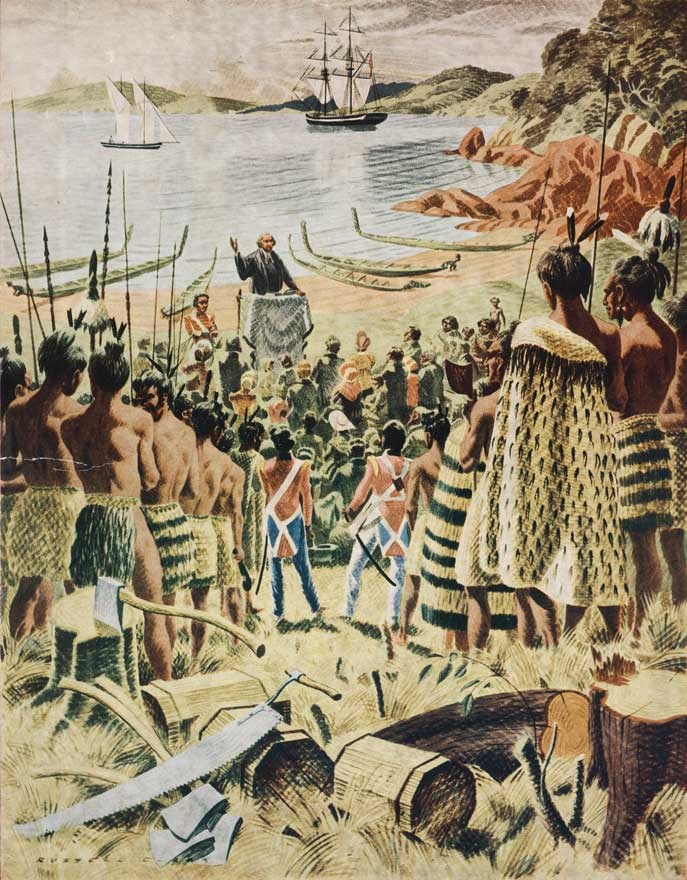
Russell Clark's reconstruction of Samuel Marsden's Christmas Day service at Hohi (Oihi) Bay in the Bay of Islands in 1814 is how many New Zealanders have visualised the first Christmas service in this country.
Then followed what we may call the first missionary effort which failed spectacularly for reasons which Davis addresses in his letters and journal.  Davis was part of the second effort which was much more successful.  He arrived in 1824 and began work in Paihia, alongside William and Henry Williams.

It was difficult and dangerous work.  One of the dangers was famine.  It took years for the missionaries to organize to provide a sufficient supply of food for the missionary families and their dependants.  Richard Davis was at the forefront of meeting this challenge.  He had been sent to New Zealand in part because he was a careful and successful farm manager in the UK.  Part of his longer term responsibility was to break in a farm in the Bay of Islands area in order to grow sufficient crops, including livestock, to provide a steady supply of sustenance for the missionaries and their dependants.

A second continual danger was the threat to their own persons from the local (or marauding) Maori tribes.  Cannibalism at the time was a "normal" part of tribal life.  In part it was the Maori solution to the lack of adequate food.

In April 1925 he wrote of his conviction that in the end the Gospel of Christ would win over the indigenous Maori.  He was aware, however, that it may be at the cost of their lives.
He writes:
This mission is at present in a dark state, surrounding by enemies before and behind.  We have foes without and foes within.  The hand of the Lord is clearly to be seen in the formation and protection of this mission.  I am fully persuaded that the standrd of the Gospel is upraised here, and that all the host of hell cannot pull it down.  We may be obliged for a time to leave New Zealand.  We may be entombed in the bowels of these cannibals.  But the cause of Christ must prosper.  Satan's power cannot hinder it.

. . . . The civilisation of the natives has been attended to, and their temporal concerns have been greatly improved.  But the proper work of missions, the evangelization of the heathen, is the first duty to be discharged.  [Richard Davis, Memoirs, p. 68] 
He then expresses that his hope for an eventual positive response to the preaching of the Gospel to the Maori, which he was increasingly able to do in their own language, would come not from human activity to lift the standard of living of Maori.  Without the work of the Spirit of God Himself, through the preaching of the good news of Jesus Christ, feeding and clothing Maori would have only negative effects.
Must we prepare, nay, can we prepare, our hearts for the reception of the Spirit of Christ?  Certainly not.  So I am fully convinced, that all we an do in New Zealand to civilize the natives will produce no spiritual result.  [Here Davis alludes to the ineffectual and erroneous strategy of the earlier cohort of missionaries, now no longer working in the mission.]  They [the Maori] have been fed to the full, and now, like Jeshurun of old, they are waxed fat, and kick.  [Ibid.]

Nothing but the preaching of the Gospel of Christ will benefit the souls of the New Zealanders.  This, my dear sir, is my decided conviction.  And in this conviction I trust, through grace, to live and die.
 The same issues still roil through New Zealand.  We have seen successive governments attempt to save people by feeding and clothing them.  On almost every possible measure, it has been a dismal failure.

  • Maori make up 51 percent of our prison population, but only 14.6 percent of the population. 
  • New Zealand has one of the highest proportions of ecstasy and amphetamine abusers in the world a United Nations survey has found.
  • Almost 30% of children in New Zealand live in sole parent families. For Maori, 72 percent of births were to married parents in 1968; by 2015 the proportion had fallen to just 21 percent.

We could go on. It is our firm conviction that Government social welfare programmes will only result in a significant proportion of recipients  "waxing fat, then kicking".  Davis was right.  The Gospel of Christ is the only sustainable source of life, fundamental to all others.

Monday, 26 February 2018

Imperial Legacy

Forgotten Glories

These days the Imperial British Empire is largely regarded with vituperative scorn amongst many historians.  Others express embarrassment.  What is left of the old imperial "structure" is now reflected in the Commonwealth of Nations.  This has been eagerly and persistently maintained by Elizabeth II as representing the best of the humanitarian ideals underlying the old Empire.  

In many ways it is a "force" to behold.  We suspect that as time passes, the better fruits of Imperial Britain will come more into focus and attention.  But for the present the injustices, the use of force, the disregard for local populations, and the atrocities of the Empire predominate.  More time is needed for a balanced appraisal to emerge.  As one historian put it
The British Empire is too recent to be regarded by most commentators with the detachment that can be applied to older empires such as the Ottoman or the Mughal.  When the latter used violence against their subject peoples, they can be said to have carried out "stabilizing operations"; but when the British did so, they committed "war crimes," even "genocide."   [Robert Tombs, The English and Their History (New York: Alfred A. Knopf, 2015), p. 785.]
The inability of the present generation of historians to deal objectively with the matter is patently obvious.  This is particularly the case when regimes which replaced the administration of the Empire turned out to be more oppressive and incompetent than the British administration they replaced.

Thursday, 28 May 2015

The First Criminal Sitting of the Supreme Court

Justice Versus Colonialism

In November 1841 a terrible murder of five people occurred in New Zealand--a woman, a servant, and three children--occurred in the Bay of Islands.  The murderer was one Maketu; his victims were pakeha and Maori.  The date is significant because it closely followed on the signing of the Treaty of Waitangi in the North.  Signatures were still being secured in parts of the country further south.

Missionary, Richard Davis who had arrived in Paihia in 1824, was by now a very fluent Maori speaker.  In a letter he describes what subsequently happened:
It was Maketu's own father who came forward and gave him up.  A meetings of chiefs was called at Paihia, and Wake Nene, Heke, Tawai (Tawhai), Patuone and Pomare, all leading chiefs of the Ngapuhi tribe, discussed the situation.  Heke was furious at the surrender; he would not in the least have minded the Maoris shooting the murderer, but to pass over the whole adjudication to the British Government, was, he thought, to give up his independence.  But the others insisted that the young man should be tried according to the law that by treaty they had accepted, and sent a letter to Hobson, expressing their loyalty to the Queen and their confidence in British justice. [Cited by Florence Keene, By This We Conquer, (Keene: Whangarei, 1974), p.34.]
This incident is significant insofar as it shows how the majority of Ngapuhi chiefs understood that the signing of the Treaty meant a ceding of sovereignty to, and government by, the British Crown.  Hone Heke (of the flagpole fame) was of a different mind.  The subsequent trial was the first of the Supreme Court of NZ.  Davis was asked to be an interpreter of the proceedings for the Maori witnesses and attendees at court.

Thursday, 4 December 2014

We Have No Memory

Jaded Secularism and Its "Tricks"

This year New Zealand will "mark" the 200th year since the Gospel of Jesus Christ was first proclaimed in New Zealand (as far as we are able to tell).  Our Lord had commanded that we, his servants, proclaim to the farthest reaches of the earth, His death on behalf of all men for the forgiveness of sin.  New Zealand is about as far away from Jerusalem (where He laid down this command) as is possible to get.  Thus, in terms of biblical theology and Christian eschatology, the first coming of the Gospel to this far flung country is of great symbolic significance, at the very least.

For that reason alone all Christians everywhere should take a great interest in the coming of the Gospel to a far-away land, where the inhabitants were lost in the dark night of sin.  But the nation as a whole will barely notice this bicentenary.  That's because New Zealand is officially a secular country, which means that the religion of secularism is its established religion.  To our official, established religion, the coming of Samuel Marsden to New Zealand to preach the Gospel on Christmas Day 1814 is more of an embarrassment than anything else.  It reflects a former, benighted age when people superstitiously believed in gods rather than stochastic atoms. 

Paul Moon, one of our leading historians of the period, laments the present studied ignorance of the event.

Saturday, 12 April 2014

Memorial Stones

Humble Heroes of the Faith

Missionary endeavour and the acceptance of the Gospel by Maori have been pretty much air brushed out of recent accounts of New Zealand history.  Secular humanism is a trick the living of our day are attempting to play upon the dead.  We Christians have a duty to ensure that the past is not lost.  To that end, Keith Newman's Bible and Treaty: Missionaries Among the Maori--A New Perspective [London: Penguin Books, 2010] is a much needed corrective to the current whitewashing. 

Contained in Newman's book is a gripping story of one Taumata-a-kura, an East Cape, Ngati Porou tribesman.  He had been taken as a slave during a raid by the northern Ngapuhi tribe, but in the early 1830's found his way to the mission school at Waimate, where he learned to read and write, and was instructed in the basic doctrines of the Gospel.  He eventually made his way back to his family and tribe.
One account describes the reunion of Taumata-a-kura with his people as "aioio ana te noho a te iwi" (black with people who hung onto his every word).  Ngati Porou believed he had been lost forever but now here he was, as if he had returned from the dead.  Rumours of his return, along with his message of an "atua hou" (a new god), had reached up into the Waiapu Valley before he even set foot in his homeland.  [Newman, p. 118.]

Thursday, 9 January 2014

A Much Needed Corrective, Part IV

Final Notes and Unfinished Business

We strongly recommend to our New Zealand readers in particular that they read Keith Newman's Bible and Treaty: Missionaries Among the Maori--a New Perspective (New York: Penguin Books, 2010).  It is part of our heritage with which all New Zealand Christians ought be familiar. 

In this final post, we want to call attention to three aspects of Newman's book which are worth considering. 

The first is the deleterious role of the New Zealand Company ("NZC")--a company largely associated with Edward Gibbon Wakefield formed to promote and profit from British colonial settlement in New Zealand.  In order to trade, NZC needed to secure supply of land.  Settlers from Great Britain were offered land upon which to settle in New Zealand.  NZC actively went around trying to secure that land in order to on-sell it.  They bought it from Maori. 

The Company was not at all scrupulous in patiently working through the complex issues of buying land from Maori, where title was a nebulous concept and contentious historical reality.

Monday, 6 January 2014

A Much Needed Corrective, Part III

Disinterring The Good From the Bones

As we have often recounted, Voltaire astutely observed that the writing of history is a trick the living play upon the dead.  He would have known.  He lived amidst and participated in one of the great acts of historical revisionism.  The "historians" of the Enlightenment deliberately rewrote and recast Western history to become of narrative of classical (pagan) glories, followed by a millennium of Christian ignorance, superstition, and darkness.  The classic of the genre (but by no means an isolated case) is Edward Gibbon's Decline and Fall of the Roman Empire.  Voltaire's sneer is apropos.

Early New Zealand history has been similarly recast.  The trick played upon the dead in this instance--both Maori and pakeha--is that Christianity in general and the missionaries in particular were a perfidious influence.  The myth of the noble savage has emerged once again.  Rousseau would have been very pleased. 

Keith Newman's Bible and Treaty: Missionaries Among the Maori--a New Perspective (New York: Penguin Books, 2010) is a much needed corrective to this tsunami of scurrilous revisionism.  In the conclusion, he summarises by means of ironic understatement some aspects of the "great trick":

Friday, 3 January 2014

A Much Needed Corrective, Part II

God Moving in Mysterious Ways

We plan to write a couple of supplementary pieces on  Keith Newman's Bible and Treaty: Missionaries Among the Maori--a New Perspective (New York: Penguin Books, 2010).  These will not strictly be in the category of reviews, but reflections upon just some of what is contained in this valuable book. 

The first is the persistence, patience, and courage of the earliest missionaries.  They were a mixed lot and for ten years laboured in New Zealand under extremely tenuous circumstances, ending up with little to show for their efforts.  Often times they were in danger of losing their lives. 
The missionaries were relatively safe under Hongi's protection, but it was a peace fraught with tension.  Marsden had traversed much of the upper North Island, built relationships with many chiefs and promised missionaries would soon come and live among them.  However, those sent to bring the "good news" remained landlocked at Rangihoua, often fearing for their lives.  After a decade in New Zealand, the missionaries had little to show.  (Op cit., p. 60). 
From a mere human perspective, one would wonder how it could be that any good would ever come of their efforts.  They were a  messy bunch, those early missionaries.