Nothing But the Gospel Preached Will Suffice
In recent weeks we have been reading
A Memoir of the Reverend Richard Davis (for 39 Years a Missionary in New Zealand) by the Reverend John Noble Coleman [London: James Nisbet and Co., 1865.]
The book, of course, is out of print. It consists of a summary of Richard Davis's correspondence back to the United Kingdom, together with journal entries. Davis was one of the very early missionaries to New Zealand. The Gospel was first officially preached by the Reverend Samuel Marsden on Christmas Day, 1814 at Hohi Bay in the north of the North Island.
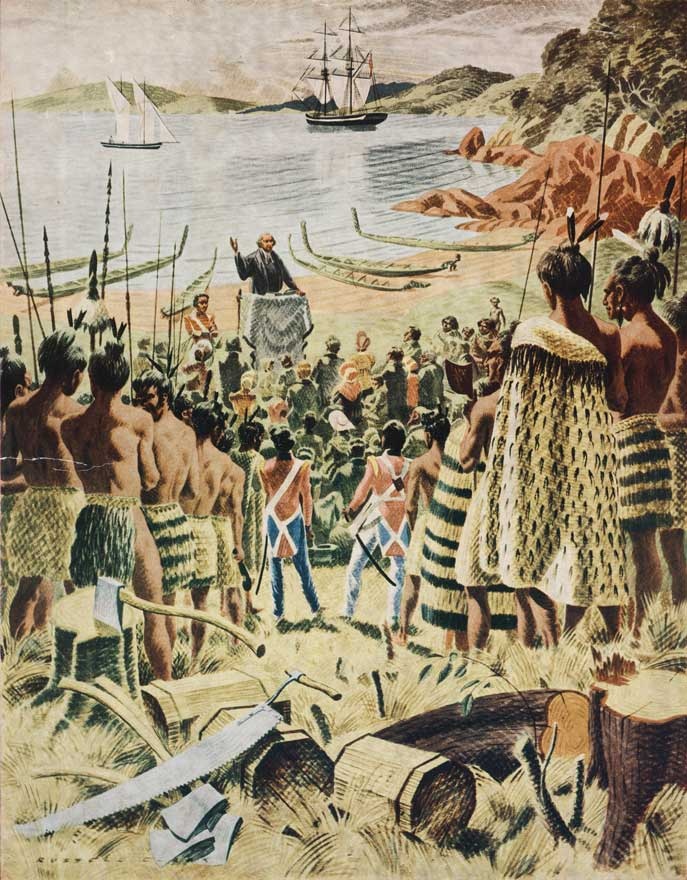 |
| Russell Clark's reconstruction of Samuel Marsden's Christmas Day service at Hohi (Oihi) Bay in the Bay of Islands in 1814 is how many New Zealanders have visualised the first Christmas service in this country. |
Then followed what we may call the first missionary effort which failed spectacularly for reasons which Davis addresses in his letters and journal. Davis was part of the second effort which was much more successful. He arrived in 1824 and began work in Paihia, alongside William and Henry Williams.
It was difficult and dangerous work. One of the dangers was famine. It took years for the missionaries to organize to provide a sufficient supply of food for the missionary families and their dependants. Richard Davis was at the forefront of meeting this challenge. He had been sent to New Zealand in part because he was a careful and successful farm manager in the UK. Part of his longer term responsibility was to break in a farm in the Bay of Islands area in order to grow sufficient crops, including livestock, to provide a steady supply of sustenance for the missionaries and their dependants.
A second continual danger was the threat to their own persons from the local (or marauding) Maori tribes. Cannibalism at the time was a "normal" part of tribal life. In part it was the Maori solution to the lack of adequate food.
In April 1925 he wrote of his conviction that in the end the Gospel of Christ would win over the indigenous Maori. He was aware, however, that it may be at the cost of their lives.
He writes:
This mission is at present in a dark state, surrounding by enemies before and behind. We have foes without and foes within. The hand of the Lord is clearly to be seen in the formation and protection of this mission. I am fully persuaded that the standrd of the Gospel is upraised here, and that all the host of hell cannot pull it down. We may be obliged for a time to leave New Zealand. We may be entombed in the bowels of these cannibals. But the cause of Christ must prosper. Satan's power cannot hinder it.
. . . . The civilisation of the natives has been attended to, and their temporal concerns have been greatly improved. But the proper work of missions, the evangelization of the heathen, is the first duty to be discharged. [Richard Davis, Memoirs, p. 68]
He then expresses that his hope for an eventual positive response to the preaching of the Gospel to the Maori, which he was increasingly able to do in their own language, would come not from human activity to lift the standard of living of Maori. Without the work of the Spirit of God Himself, through the preaching of the good news of Jesus Christ, feeding and clothing Maori would have only negative effects.
Must we prepare, nay, can we prepare, our hearts for the reception of the Spirit of Christ? Certainly not. So I am fully convinced, that all we an do in New Zealand to civilize the natives will produce no spiritual result. [Here Davis alludes to the ineffectual and erroneous strategy of the earlier cohort of missionaries, now no longer working in the mission.] They [the Maori] have been fed to the full, and now, like Jeshurun of old, they are waxed fat, and kick. [Ibid.]
Nothing but the preaching of the Gospel of Christ will benefit the souls of the New Zealanders. This, my dear sir, is my decided conviction. And in this conviction I trust, through grace, to live and die.
The same issues still roil through New Zealand. We have seen successive governments attempt to save people by feeding and clothing them. On almost every possible measure, it has been a dismal failure.
- Maori make up 51 percent of our prison population, but only 14.6 percent of the population.
- New Zealand has one of the highest proportions of ecstasy and amphetamine abusers in the world a United Nations survey has found.
- Almost 30% of children in New Zealand live in sole parent families. For Maori, 72 percent of births were to married parents in 1968; by 2015 the proportion had fallen to just 21 percent.
We could go on. It is our firm conviction that Government social welfare programmes will only result in a significant proportion of recipients "waxing fat, then kicking". Davis was right. The Gospel of Christ is the only sustainable source of life, fundamental to all others.

