Saturday, 25 May 2019

Buyers' Remorse

Taxpayers' Taken For a Ride

Phil Twyford used to "work" for Oxfam.  He rose up the ranks, firstly by becoming the Executive Director of Oxfam New Zealand. Then he moved on to Washington.  According to his "blurb", 
Phil’s strong belief in justice led to him becoming Oxfam’s Global Advocacy Director, based in Washington DC. 
From there his "strong sense of justice" led him to entering politics in New Zealand and becoming the present Minister of Housing.  He took this very responsible position with no commercial experience.  Mind you, deleterious as this may be, it is not unusual.  Most Labour MP's in New Zealand either worked as bureaucrats or unions, before entering politics.  But because Phil made it to Washington, he was regarded within the ranks as a bit of a genius.

His first great achievement as Minister of Housing was to launch KiwiBuild.  This madcap scheme put the Crown as the guarantor of houses for first-home buyers.  This cohort had been identified as the most needy.  Once they got on the "property ladder" they would be away, able to move "up the ladder" by selling and buying houses as they chose.  This was just the sort of scheme a bureaucrat with no commercial experience and zero understanding of how free markets actually work would put together.

How is the madcap scheme going?

Friday, 24 May 2019

Insidious Creep of Political Intolerance

Don't Let Politicians Use The Law to Shut Down Speech They Don't Like

David Seymour


Since the Christchurch terrorist attack, politicians and the media have been consumed by debates over gun legislation and social media companies.
But the events of March 15 have also drawn the Government's attention to an issue that could have much deeper implications for every New Zealander: whether we need new laws to restrict so-called "hate speech" from being used against particular groups.
On Wednesday, Green MP Golriz Ghahraman claimed hate speech leads directly to violence. That's a tenuous argument.
Even Helen Clark, who argues for tougher hate speech laws, admits protecting religion from hate speech wouldn't have prevented the Christchurch attack. Her foundation's report says "it is difficult to establish a causal link between online hate speech and violence".
Another argument advanced by Ghahraman is that hate speech can be objectively defined. That's not true. Where the line between fair criticism and hate speech lies can only depend on opinion.
Professor Paul Moon, of the Auckland University of Technology, believes no country has been able to clearly define hate speech.

The Times of Our Lives

Let God Arise

We have witnessed the deaths of our parents; we have seen our children grow up, marry, and produce children of their own.  Yet despite this long time and the passing of generations we have never witnessed throughout our lifetime a coronation of a monarch of England and the Commonwealth.  The explanation, of course, is straightforward enough: Queen Elizabeth has been the longest-lived and longest-reigning British monarch.

When her heir eventually assumes the throne he will be invested via the historical Coronation Ceremony.  British historian, Nick Spencer provides a description of the coronation ceremony which we have never observed nor witnessed in our lifetime.  (The description is of Elizabeth's Coronation Ceremony.  One presumes that the next monarch will be a male--either Prince Charles or Prince William.)

The coronation has its origins in a service first used in 973.  Although modified greatly since then, it retains the same basic structure, being located in a Christian church, presided by a Christian minister and based on the service of the Eucharist. 
According to the most recent precedent . . . the service which, is held in Westminster Abbey, begins with the choir singing an anthem based on Psalm 122.  Once seated, the monarch promises, among other things, to 'maintain the Laws of God and the true profession of the Gospel' and to uphold the cause of law, justice, and mercy.  She is presented with a copy of the Bible ('the most valuable thing that this world affords) by the Moderator of the Church of Scotland, who says to her, 'Here is Wisdom; this is Royal Law; these are the lively Oracles of God.'

Thursday, 23 May 2019

Hypocrisy On a Grand Scale

Inclusivity Means Accepting Everyone's Views - Even Israel Folau's


Karl du Fresne
Dominion Post

Something's not quite right here. The 21st-century buzzwords are diversity and inclusivity, but they seem to be applied very selectively.

It seems we're in favour of diversity and inclusivity if we're talking about race, colour, gender and sexual identity, the latter two of which keep spinning off into ever-new permutations. But puzzlingly, we're only partially tolerant when it comes to religious belief.

We are encouraged to be tolerant toward Islam, especially since the Christchurch atrocities, and so we should be. The right to practise one's religion, at least unless it interferes with the rights of others, is one we should all unquestioningly support.  This applies even when secular society disapproves of some of those religions, or scratches its collective head in bemusement at their practices and beliefs.

But if freedom of religion is one cornerstone of a free society, so is freedom of expression, which includes the right to subject religion, along with every other institution of society, to critical scrutiny and even ridicule.

Virtually all religions – whether we're talking Catholicism, Mormonism, Judaism, the Destiny Church or the Exclusive Brethren – possess what, to non-believers, are quirks, absurdities, hypocrisies and cruelties that render them ripe for mockery and condemnation.  For decades, comedians and satirists have taken joyous, blasphemous advantage of this freedom. How people laughed, for example, at Monty Python's The Meaning of Life, with its wickedly subversive song Every Sperm is Sacred – a dig at Catholic teaching on birth control.

If it offended devout Catholics – well, tough. Freedom to ridicule is the flipside of freedom to worship.

Daily Meditation

Avoiding a False Theology of Suffering

Martin Luther’s tenure in the monastery was a time of spiritual desperation. He was tormented by unrelieved guilt coupled with a gripping fear of the wrath of God. Why would an educated man retreat to a barren cell and abuse himself with self-inflicted physical punishment? Why would a believer go out of his way to find personal suffering?
The answer may be found partially, though not totally, in a concept that emerged in church history that equated suffering with merit. Monks fled to the desert to seek rigorous forms of asceticism and self-denial, not only as a form of spiritual discipline to maintain a healthy dependence on the grace of God, but also in quest of sanctifying merit.
A biblical text that was often cited as scriptural warrant for such activity is Colossians 1:24. Paul writes, “I now rejoice in my sufferings for you, and fill up in my flesh what is lacking in the afflictions of Christ, for the sake of His body, which is the church.” The key words of this verse are “fill up … what is lacking in the afflictions of Christ.”
A false theology of suffering emerged that was built on the hypothesis that the meritorious suffering of Jesus, though necessary for the redemption of God’s people, is not complete—there is additional merit that can be added to it by the suffering of the saints.

Coram Deo

Reflect on this truth: The suffering of Christ cannot be augmented by your merit. It is complete.

Passages for Further Study

What Tangled Webs We Weave

Prickly Pear Trees, Rachel Dolezal, and Rights of Choice

Here is the received wisdom from someone who should know better.

You can’t choose your colour, race, ethnicity or nationality.  Golriz wants to include “gender, sexual orientation, religion, or disability.
You basically don’t choose your gender, sexual orientation or disability so I agree there may be a case for including those. I suspect if they do, the majority of complaints will be people alleging speech attacking white men should be prosecuted so be careful of what you ask for.
But religion is a choice. Billions of people around the world choose whether or not to follow a particular religion, or none at all. Sure in some countries there is great cultural pressure to be of a particular religion, but in NZ we have true freedom of religion.  [David Farrar, Kiwiblog]
The weasel word is this:  "You basically don’t choose your gender, sexual orientation . . . ".  First up, what is the meaning of "basically" in Farrar's sentence?

Wednesday, 22 May 2019

In the End We Will Conquer


Inescapable Incrementalism

INTRODUCTION

Recent years have seen the rise of a pro-life abolitionism, and there are aspects of this that have been quite good. We could all use a little more impatience with some of our pro-life politicos, too many of whom have been like the constables in Penzance. “We go, we go, we go!” “Yes, but you don’t go.”

At the same time, the demand for the immediate abolition of all human abortion has sometimes taken a form that has confused a situation that was already confused enough. There are two things we require—the first is that we keep the mission clear, and second, that we keep the demands simultaneously realistic and inexorable. More about what that means shortly.

THE MISSION

So what is the goal? What is it that we must keep clear? In all that follows, keep in mind what the long game has to be. For anyone with consistent, biblically-based pro-life convictions, the only satisfactory outcome is the abolition of all human abortion—first, in the law, and second, with regard to the actual practice of it, as much as can be restrained by enforcement in a fallen and imperfect world. That is the mission.
So what do I mean by realistic and inexorable?

CONQUERING CANAAN

Let us take Israel’s conquest of Canaan as a historical event that illustrates the nature of the challenge and difficulty.

Daily Meditation

Exercising Your Power of Choice

Does man have a free will? This question is one of the most frequently asked questions of theology. At times, it is not voiced as a question but as an objection to the whole idea of a sovereign God.  
At the heart of the problem is the definition of free will. What are we saying when we assert that man has a free will? Stated briefly, free will simply means that man has the ability to choose what he wants. Such ability requires the presence of a mind, a will, and a desire. If these faculties are present and functioning in man, that man has a free will. 
Free will does not mean that man can choose to do anything he pleases and necessarily succeed. We may choose to fly without the aid of mechanical devices. We can fall through the air by ourselves, but we cannot fly through it. We lack the necessary natural equipment (in this case, wings) to fly. This does not mean, however, that we are not free. It does mean that our “freedom” is limited by our natural physical limitations. My will may be outvoted by the will of a majority or by some higher power. Such conflicting power does not eliminate my freedom but may surely impose limits on it.
One of the most important limits on my freedom is myself. If we examine the workings of the will closely we run into a point of irony that is often overlooked in discussions about free will. The point is this: Not only may I choose what I want, I must choose what I want if my choice is really to be free. Choice is made according to desire. Without desire there could be no free choice—certainly no moral choice. 

Coram Deo

God gave you a free will to choose. You choose according to your desires. Will your present desires lead to wise choices for the future?

Passages for Further Study


Five Myths About Palliative Care

Taking Care of the Dying

Voice for Life--a site opposed to euthanasia and promoting palliative care--has put up a useful summary of five myths often encountered about palliative care of the terminally ill or aged.


https://www.facebook.com/203953359629611/posts/2476963512328573?s=1130283936&v=i&sfns=mo

It's worth reading.

JT

Tuesday, 21 May 2019

Euthanasia

Practitioners Sounding Alarm 

Developments in Europe

Christian Info


The law decriminalizing euthanasia in Belgium was passed in May 2002. This law was intended to create a framework allowing a patient to make a request for euthanasia and a doctor to access it under certain conditions, without the doctor is in a position to commit a criminal offense.

Since Belgium has taken this step, the debate on the legalization of euthanasia has been taking place in France and elsewhere in Europe. It has even become a campaign theme in Spain . Yet, with 17 years of hindsight on Belgian practices, many practitioners are sounding the alarm.

The Belgian collective  Euthanasie Stop , made up of 43 people including 35 doctors and medical professors, a lawyer, an honorary magistrate, a palliative care ethicist, a rabbi, an imam and a canon, decided to inform and question. 
"This website presents itself as a space of public expression, open to all those who wish to make a discordant voice heard. "
Among them, the doctor oncologist at the University Hospital Leuven is at the forefront of this bioethical debate. In his book Euthanasia and Assisted Suicide, Lessons from Belgium , an international panel of experts examines the implications of legalized euthanasia and assisted suicide. These experts thoroughly analyze Belgian data and question "one of the most difficult ethical issues of our time, using law, philosophy and medical disciplines".

In France, the debate is decided between the doctors. If in 2013, an IPSOS survey revealed that 60% of the surveyed physicians were generally in favor of "active" euthanasia (which involves the act of a third party who gives a dying person a lethal substance or provides it), many are not in favor.

Jean Leonetti, author of the 2005 law on patients' rights and end of life, and co-author of the 2016 law, spoke very clearly about his fears regarding the legalization of euthanasia in France. , for  Le Parisien
"I continue to defend the idea that giving death to a person, even at his request, constitutes a frank rupture of fraternity and solidarity. It is not because people ask for it that we must meet their expectations. "
In 2018, the Unit and Palliative Care Team doctors in the Northern Department testified to the "intentionality of their mission", which "is never to shorten life but to relieve symptoms." He then spoke in these terms on Le Figaro Santé .

Daily Meditation

Rediscovering the Law

Israel’s reformation came via a rediscovery of the law, which created a brief awakening to the bankruptcy of a corrupt nation. As a young man, King Josiah began the process of reformation with a spiritual purge, a cleansing of pagan elements from the religious life of the nation. 
A few years later, Hilkiah found the book of the law of the Lord given by Moses. A scribe brought the book to King Josiah and read it to him. The result was dramatic: “Now it happened, when the king heard the words of the Book of the Law, that he tore his clothes” (2 Kings 22:11). 
Josiah was awakened to the greatness of the wrath of God. He realized that God had been pouring out that wrath on the nation of Israel. He further understood that this divine judgment on the nation was a direct result of sin.
The most apparent immediate change in the national reform of Israel was seen in the restoration of true worship, a worship purged of idolatry and rooted in a sound understanding of the character of God and of His law.
We need a new discovery of the law of God and the Word of God in our land. Yes, it needs to be rediscovered in the public square—but even more importantly it must be rediscovered in the house of God. 

Coram Deo

Renew your personal commitment to the Word of God. Start today!

Passages for Further Study

An Enduring, Popular Myth

State Tyranny and Malthusian Rubbish

Some years ago we read Paul Ehrlich's, The Population Bomb.  Fortunately, at the same time we were also reading the Scriptures.  It did not take too long before the sanity of the Bible exposed the folly of Mr Ehrlich's doomsday proclamations.  But myths and doomsday proclamations have a way of lingering on.

Consequently, every so often it's helpful to take an antidote, lest we are tempted yet again to drink Environmentalist Kool-Aid. 

How Big of a Problem Is Overpopulation?
By Chelsea Follett

Unwarranted panic about overpopulation is a big problem that has led to human rights abuses and much pointless suffering.

Consider the long history of overpopulation alarmism, and how the doomsayers’ fears have failed to materialize again and again. Two centuries ago, Thomas Malthus’s Essay on Population warned that out-of-control population growth would deplete resources and bring about widespread famine. His preferred solution was to decrease the birth rate by delaying marriage, but if that didn’t work he endorsed some rather extreme measures to slash the population. To prevent famine, he thought it was morally permissible to “court the return of the plague” by making the poor live in swamps and even to ban “specific remedies for ravaging diseases.” After Malthus died, the Industrial Revolution brought about unprecedented prosperity that funded the construction of safe water supplies and sewage systems at a scale never before achieved. Living standards were transformed and lifespans lengthened. As farms mechanized, food became more plentiful even as the population grew. Famine became rarer. Yet Malthus’s ideas proved enduringly popular.

Monday, 20 May 2019

Turning the Tables

Sweet Home

Alabama has done a wonderful thing in outlawing abortion. I want to commend her legislature and her governor for doing the right thing, and every thoughtful Christian should be humming under their breath: “in Birmingham they love the governor, we all did what we could do.”
There will be many occasions in the months to come to write more about this issue and the pending showdown it represents, but I wanted to say just one thing about all of it at the outset.
In 1973, the Roe decision was a federal power move, calculated to pressure the states. Unfortunately, all the states went along with this ghoulish decision, including those states which would have continued to outlaw abortion if it had been left up to them. They were willing to outlaw abortion, but were not willing to fight with the federal government over their right to outlaw abortion.
But thanks to a generation of pro-life activism, the issue has been kept alive (unlike millions of children), and it appears that a number of states are now showing a willing to have that fight.

Daily Meditation

Climbing out of the Mire

Our souls cannot climb out of the mire of sin because they are dead. Salvation comes not to those who cry out, “Show me the way to heaven,” but to those who cry, “Take me there for I cannot.” 
Lest we see the sinner’s prayer as mere technique, we must remember that Christ raises the dead that they might walk. We do not mumble the magic words and then wait to die. Christianity is about spiritual growth as well. It is about work, the hard work of sanctification. Regeneration is monergistic, God’s work alone. Sanctification, the process by which we are made holy, is synergistic, God’s work with us. 
God’s part is easy for Him. He needs no shortcuts because He never tires. We, though, must ever fight the temptation to seek the shortcut. No technique will make us holy. No technique of the Devil’s, though, can stop the process of Christ making us into His image. Those whom He calls He sanctifies.
Our sanctification requires the Spirit of God and, because He has so ordered His world, sanctification requires the disciplined and repeated use of the means of grace. Five minutes a day of Bible study smells like technique. Arid, it is sure to fail. We must immerse ourselves in the Word of God. Then, as Jesus promised, we will know the truth and the truth will set us free. Then we will be His disciples (John 8:31–32). 

Coram Deo

Remember, God is at work in you. He never tires. Give thanks for the process that is underway.

Passages for Further Study

The NZ Minister of Education Does the Big 180

Back to the Future

It seems to us that the educrats and teacher unions in New Zealand have taken a big hit, resulting in a substantial step backwards to the future.  

The government education system, at least in senior and secondary schools has been under review.  As a result the system looks like it is going to take a big unexpected reverse step.  We figure that represents significant progress!  Some have been putting it down to the political pressure from larger, more successful schools.

The old view used to be that no student should depart or graduate from a New Zealand school without being judged as educated and competent in some subject or other.  In the relentless drive to produce students who had successfully graduated in something, thousands of "unit standards" (that is, subjects) have been created.  Over 9,000.  Subject inflation out of a misplaced drive to affirm all NZ school students in at least something or other will now been trimmed right down.

Saturday, 18 May 2019

Young Christian Girls Forced Into Marriages

Pakistani Christian girls trafficked to China as brides


1 of 5
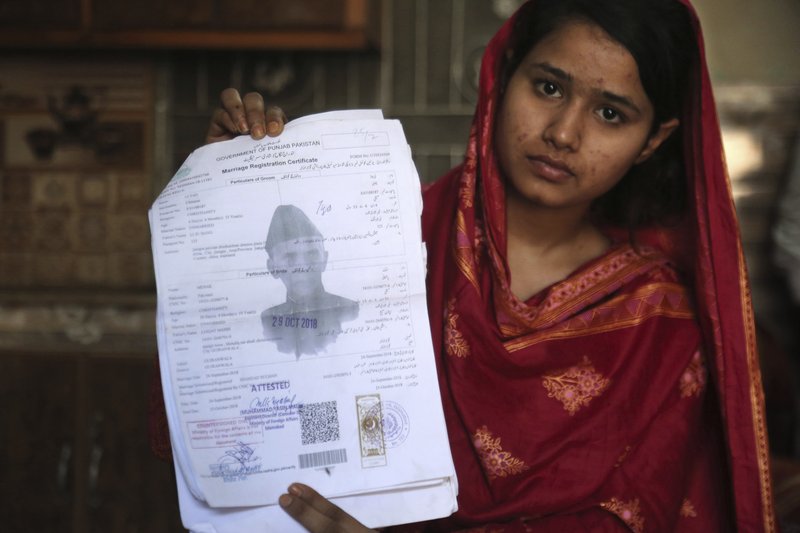
In this April 14, 2019 photo, Mahek Liaqat, who married a Chinese national, shows her marriage certificate in Gujranwala, Pakistan. Poor Pakistani Christian girls are being lured into marriages with Chinese men, whom they are told are Christian and wealthy only to end up trapped in China, married to men who are neither Christian nor well-to-do, and some are unable to return home. (AP Photo/K.M. Chaudary)

GUJRANWALA, Pakistan (AP) — Muqadas Ashraf was just 16 when her parents married her off to a Chinese man who had come to Pakistan looking for a bride. Less than five months later, Muqadas is back in her home country, pregnant and seeking a divorce from a husband she says was abusive.
She is one of hundreds of poor Christian girls who have been trafficked to China in a market for brides that has swiftly grown in Pakistan since late last year, activists say. Brokers are aggressively seeking out girls for Chinese men, sometimes even cruising outside churches to ask for potential brides. They are being helped by Christian clerics paid to target impoverished parents in their congregation with promises of wealth in exchange for their daughters.  
Parents receive several thousand dollars and are told that their new sons-in-law are wealthy Christian converts. The grooms turn out to be neither, according to several brides, their parents, an activist, pastors and government officials, all of whom spoke to The Associated Press. Once in China, the girls — most often married against their will — can find themselves isolated in remote rural regions, vulnerable to abuse, unable to communicate and reliant on a translation app even for a glass of water.
LanternLanterns hang over the front door of the former home of Chinese man, Li Tao, and his Pakistani bride. Mahek Liaqat in Li's hometown of Chenlou, in Pei County in eastern China's Jiangsu province. (AP Photo/Dake Kang)
“This is human smuggling,” said Ijaz Alam Augustine, the human rights and minorities minister in Pakistan’s Punjab province, in an interview with the AP. “Greed is really responsible for these marriages ... I have met with some of these girls and they are very poor.”

Daily Meditation

Becoming Part of the Bride

When Christ purchased His bride, He bought a bride who was “damaged merchandise.” His bride was sullied by manifest impurities. She was covered by spots and marred by wrinkles. Yet what He purchased He also sanctifies: 
Husbands, love your wives, just as Christ loved the church and gave himself up for herto make her holy, cleansing her by the washing with water through the word, and to present her to himself as a radiant church, without stain or wrinkle or any other blemish, but holy and blameless. (Eph. 5:25–27NIV)
Christ prepares His bride for His wedding feast envisioned in Revelation:  
Then the angel said to me, “Write: ‘Blessed are those who are invited to the wedding supper of the Lamb!’” And he added, “These are the true words of God.” (19:9, NIV)
Every time we celebrate the Lord’s Supper, we celebrate not only the redeeming purchase price paid by the Bridegroom but symbolically the marriage feast of the Lamb to which every believer is called.

Coram Deo

Give thanks for the purchase price paid by your Bridegroom.

Passages for Further Study